Laboratory products
Biopolymers are important materials in modern pharmaceutical formulations and biomedical products. Naturally derived polymers such as sodium hyaluronate, cellulose, chitosan, gelatin, and collagen are widely used as active pharmaceutical ingredients or functional excipients due to their excellent biocompatibility, biodegradability, and well-defined physicochemical properties.
Their performance in pharmaceutical applications is closely related to their molecular characteristics, which determine important physicochemical properties such as solution viscosity, molecular dimensions, mechanical strength, and functionality in the final product. Reliable polymer characterization is therefore an essential part of quality control, product development, and regulatory compliance. Intrinsic viscosity is an important quality attribute because it reflects the hydrodynamic volume of the polymer molecules in solution and is specified in several pharmacopeial monographs.
Depending on the material and analytical procedure, solution viscometry may be used to determine relative viscosity or to derive quantities such as intrinsic viscosity and degree of polymerization. Where density is additionally determined, both kinematic and dynamic viscosity can be obtained from the sample.
Conventional solution-viscosity methods typically rely on glass capillary viscometers and require precise temperature control, repeated measurements, or, for intrinsic-viscosity determination, the evaluation of several polymer concentrations. Automated digital methods can simplify this workflow by combining controlled measurement conditions with automated data acquisition and evaluation.
This article describes the determination of solution viscosity and intrinsic viscosity using an automated digital rolling-ball microviscometer. Sodium hyaluronate is presented as an example of multi-concentration intrinsic-viscosity determination, while microcrystalline cellulose demonstrates viscosity-based characterization according to a pharmacopeial procedure. These two examples illustrate different approaches to viscosity-based polymer characterization using the same analytical platform.
The results further illustrate how digital microviscometry can simplify the analytical workflow while providing the measurement precision required for polymer quality control.
Polymers consist of macromolecular chains whose size, conformation, and molecular mass determine many of their physical properties. Dilute-solution viscometry is a well-established technique for polymer characterization, in which the viscosity of solutions prepared from a defined mass of polymer in a suitable solvent is measured. The influence of dissolved polymer chains on solution viscosity provides information about their molecular characteristics.
When a polymer is dissolved, its macromolecular chains occupy a characteristic hydrodynamic volume and increase the resistance of the solution to flow. The magnitude of this viscosity increase depends on the polymer concentration as well as on molecular size, chain conformation, polymer–solvent interactions, and temperature.
The polymer concentration, c, represents the mass of polymer in a defined volume of solution. To evaluate the contribution of the dissolved polymer, the viscosity of the polymer solution is compared with that of the pure solvent.
The ratio between solution viscosity, η, and solvent viscosity, η0, gives the relative viscosity:
The corresponding specific viscosity (Figure 1 A) describes the relative viscosity increase caused by the polymer:
ηsp = ηr - 1
To account for polymer concentration, the viscosity increase can be expressed as reduced viscosity or inherent viscosity:
Intrinsic viscosity, [η], corresponds to the common limiting value of the reduced and inherent viscosities as the polymer concentration approaches zero:
Since infinite dilution cannot be measured directly, reduced and inherent viscosities are determined for a series of sufficiently dilute polymer solutions and extrapolated to zero concentration using the Huggins and Kraemer relationships (Figure 1 B). Agreement between the two extrapolations provides an important indication of measurement consistency. Because intrinsic viscosity depends on the polymer–solvent system and temperature, it must always be determined under defined experimental conditions.
Glass capillary viscometers, particularly suspended-level viscometers such as the Ubbelohde capillary, have long been the reference instruments for dilute-solution viscometry and remain the basis of numerous pharmacopeial and standardized methods.
Viscosity is determined by measuring the time a defined volume of solution takes to flow through a calibrated capillary under gravity at a precisely controlled temperature. The measured flow time and capillary constant are used to calculate kinematic viscosity. Where dynamic viscosity is required, density must be determined separately and used for its calculation.
For intrinsic-viscosity determination, a stock solution of the polymer is prepared and diluted to obtain a series of sufficiently diluted test solutions. Typically, three to four concentrations are required for a reliable extrapolation to zero concentration.
Since solution viscosity is highly temperature-dependent, measurements are performed under strictly controlled thermal conditions, typically using a thermostatic bath. Sufficient time must be allowed for thermal equilibration before measurement, and replicate measurements are generally performed to verify the consistency of the measured flow times.
The measurement procedure is repeated for each concentration in the dilution series, including filling, temperature equilibration, measurement, and rinsing or cleaning of the capillary. While the method provides excellent accuracy and remains the reference for many standardized procedures, intrinsic-viscosity determination therefore involves multiple workflow steps, even when automated glass-capillary systems are used.
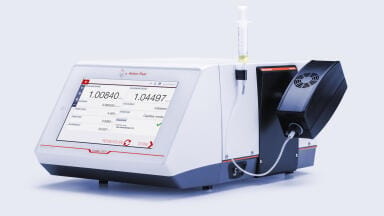
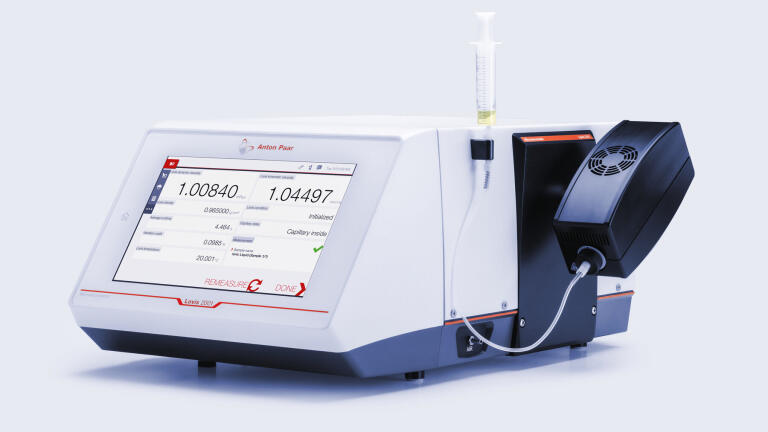
Lovis 2001 is an automated digital rolling-ball microviscometer. A ball rolls through a liquid-filled glass microcapillary positioned at a defined inclination angle. Its passage is detected electromagnetically, and the rolling time is converted into viscosity. Electromagnetic detection enables measurements independent of sample opacity or turbidity.
The microcapillary minimizes sample and solvent consumption, while integrated Peltier temperature control provides rapid and precise temperature equilibration without the need for an external thermostatic bath. Combined with short measurement times, this enables efficient measurement of complete concentration series.
The capillary block can be inclined between 15° and 80°, allowing the measuring conditions and the resulting shear rate to be adjusted for different polymer solutions. This provides additional control over the conditions under which viscosity is determined.
Where density is required, the rolling-ball microviscometer can be combined with a density meter. This enables viscosity and density to be determined within a single measurement workflow.
To simplify sample handling during intrinsic-viscosity determination, Lovis 2001 is equipped with a flow-through measuring system. Samples are introduced through a syringe connection and transported through tubing to the glass microcapillary in the temperature-controlled measuring block. After measurement, the sample leaves the system through an outlet and can be collected as waste.
The continuous flow-through design allows the solvent and polymer solutions in a concentration series to be introduced sequentially without removing the microcapillary from the measuring block. Filling, rinsing, and cleaning can therefore be performed through the same flow-through system. These steps can be carried out using the manually operated integrated syringe-driven system or further automated with a sample changer. Both approaches are suitable for concentration series, while automation is particularly advantageous when large numbers of samples and concentrations are measured and when reduced operator contact with solvents is desirable.
The integrated polymer software automatically evaluates the measured rolling times, performs the data analysis, calculates the relevant viscosity parameters, including intrinsic viscosity, and generates measurement reports.
Figure 2. Digital rolling-ball microviscometer with the flow-through system and integrated polymer software used for automated intrinsic-viscosity determination.
The performance of digital rolling-ball microviscometry for viscosity-based polymer characterization was evaluated using two different analytical approaches. Sodium hyaluronate was investigated using multi-concentration intrinsic-viscosity determination, while microcrystalline cellulose was evaluated according to the corresponding pharmacopeial viscosity procedure.
A five-point concentration series of sodium hyaluronate, ranging from approximately 0.234 mg/mL to 0.166 mg/mL, was prepared and measured at 25.00 ± 0.03 °C. The concentration series provided the basis for extrapolation of the reduced and inherent viscosities to zero concentration and subsequent determination of intrinsic viscosity. Relative, specific, reduced, and inherent viscosities were automatically calculated using the integrated polymer software.
Excellent measurement precision was achieved throughout the concentration series. Each solution was measured twice, with the rolling ball travelling in both the forward and backward directions. The forward/backward deviation ranged from 0.10 % to 0.17 %, confirming excellent agreement between both measuring directions. The corresponding variation coefficients ranged from 0.01 % to 0.03 %, demonstrating high repeatability of the rolling-ball measurements. The low experimental variation provides a reliable basis for the extrapolation, since intrinsic viscosity is determined from measurements at different concentrations rather than being measured directly at infinite dilution.
Figure 3 shows the Huggins and Kraemer extrapolations obtained from the concentration series. Both regressions showed high linearity and converged to nearly identical intercepts, resulting in intrinsic viscosities of 3,115 mL/g and 3,126 mL/g, respectively.
Figure 3. Multi-concentration intrinsic-viscosity determination of sodium hyaluronate using Huggins and Kraemer extrapolations.
Microcrystalline cellulose was investigated as an example of pharmacopeial viscosity characterization. The polymer was dissolved in cupriethylenediamine hydroxide (CED), which is sensitive to oxygen and light. Because of the sensitivity of CED to oxygen, a short measuring distance was selected for this application to minimize the measurement time.
Measurements were performed with a rolling-ball microviscometer combined with a density meter, allowing viscosity and density to be determined in a single workflow. Alternatively, density values can be entered from an external source when a density meter is not integrated into the system. In contrast to the direct intrinsic-viscosity determination used for sodium hyaluronate, the measurement and evaluation workflow for microcrystalline cellulose was configured to follow the calculation procedure specified by the European Pharmacopoeia. The kinematic viscosities of the sample and solvent were used to determine their ratio, providing the relative viscosity required for the pharmacopeial evaluation. The relative viscosity was then used to obtain the corresponding intrinsic-viscosity value from the pharmacopeial table, which was subsequently used to calculate the degree of polymerization.
Variation coefficients between 0.01 % and 0.09 % demonstrated high stability of the individual kinematic-viscosity measurements. Across three measurements, the kinematic-viscosity results showed a repeatability of approximately 1 %. The resulting degree-of-polymerization values ranged from 205 to 207, below the pharmacopeial limit of 350 for microcrystalline cellulose.
In routine analysis, the variation coefficient can additionally serve as a practical indicator of measurement consistency. Elevated values can indicate increased measurement variability and suggest that the measurement conditions or sample preparation should be verified before further evaluation.
Biopolymer characterization via solution viscometry remains an established approach for determining intrinsic viscosity and other viscosity-based polymer characteristics. The results presented demonstrate that digital rolling-ball microviscometry provides precise and repeatable measurements for both multi-concentration intrinsic-viscosity determination and pharmacopeial viscosity-based characterization.
For sodium hyaluronate, the very low variation coefficients and forward/backward deviations demonstrate the excellent repeatability of the measurements. Because intrinsic viscosity is determined by extrapolating measurements at different concentrations rather than measured directly, the accuracy of each viscosity value is essential. The minimal measurement variation resulted in well-defined Huggins and Kraemer regressions that converged to nearly identical intrinsic-viscosity values, confirming the consistency of the experimental data. This evaluation focused on measurement precision and the consistency of intrinsic-viscosity extrapolation. A direct comparison with conventional glass-capillary viscometry was outside the scope of the study.
For microcrystalline cellulose, the low variation coefficients together with the high repeatability across measurements demonstrated the consistency of the kinematic-viscosity data used for the subsequent pharmacopeial evaluation.
The two applications also demonstrate how the measurement and evaluation workflow can be configured for different analytical procedures. For sodium hyaluronate, the integrated polymer software evaluated the concentration series and determined intrinsic viscosity by extrapolation. For microcrystalline cellulose, the workflow was configured to provide the kinematic-viscosity ratio and relative viscosity required by the European Pharmacopoeia, from which the corresponding intrinsic viscosity and degree of polymerization were obtained according to the pharmacopeial evaluation procedure.
Together, microcapillary measurement, an adjustable measuring angle, precise temperature control, and flow-through sample handling provide a flexible setup for efficient polymer characterization. The integrated polymer software supports data evaluation, while the option to incorporate density values enables the determination of both kinematic and dynamic viscosity.
Baranwal, J., et al. 2022. “Biopolymers: A Sustainable Material for Food and Medical Applications.” Polymers 14: 983.
Harding, S. E. 1998. “The Intrinsic Viscosity of Biological Macromolecules: Progress in Measurement, Interpretation and Application to Structure in Dilute Solution.” Progress in Biophysics and Molecular Biology 68: 207–262.
Stepto, R., et al. 2015. “Definitions of Terms Relating to Individual Macromolecules, Macromolecular Assemblies, Polymer Solutions, and Amorphous Bulk Polymers (IUPAC Recommendations 2014).” Pure and Applied Chemistry 87: 71–120.
Gosteva, A., et al. 2023. “New Facet in Viscometry of Charged Associating Polymer Systems in Dilute Solutions.” Polymers 15: 961.
European Directorate for the Quality of Medicines & HealthCare. 2023. “Cellulose, Microcrystalline (0316).” In European Pharmacopoeia, 11th ed. Strasbourg: Council of Europe.
Cowman, M. K., T. A. Schmidt, P. Raghavan, and A. Stecco. 2015. “Viscoelastic Properties of Hyaluronan in Physiological Conditions.” F1000Research 4: 622.
Anton Paar. n.d. “Intrinsic Viscosity Determination – Dilute Solution Viscometry.” Anton Paar Wiki.
LMUK 51.7 Nov 2026



 Product directory