Chromatography
Published over 13 years ago. See the latest and most current information on Chromatography.
“The Zetasizer Nano ZS is an integral piece of equipment in our polymer characterisation laboratory,” said Daniel Krasznai, Department of Chemical Engineering, Queen's University, Kingston, Canada. “The most important features that the Zetasizer Nano ZS offers are rapidity, reproducibility, and a user-friendly interface.”
Daniel Krasznai’s supervisor, Dr Michael F. Cunningham, holds the Ontario Research Chair in Green Chemistry and Engineering at Queen's University. His team focuses on the synthesis of polymer colloids using a range of dispersed free-radical polymerisation techniques. Together with Dr Niels M.B. Smeets, and fellow collaborators Dr Pascale Champagne and Dr Timothy F.L. McKenna, they have recently published a paper in which they use the Zetasizer Nano ZS to characterise novel core-shell materials in pure water.
In this publication, Dr Smeets’ previous work on the rational design of hyperbranched synthetic polymers from Catalytic Chain Transfer Polymerisation (CCTP) was extended to provide a core-shell copolymer consisting of a synthetic core decorated with a polysaccharide shell, allowing for easy dispersion in water. Resulting data from the Zetasizer Nano ZS was used to support the anticipated core-shell structure. Because these core-shell particles are discrete and covalently linked, there is no need for micellization to create a stable colloidal system in water.
“The Zetasizer Nano ZS is a useful instrument for us since the average particle size, particle size distribution, and zeta potential of our materials are key parameters in terms of understanding the fundamental issues surrounding particle creation and stabilisation, as well as reaction kinetics and macromolecular architecture. A particularly unique application of the Zetasizer Nano ZS is that we can measure the average particle size and zeta potential of some of our samples using undiluted suspensions (of a few wt% in concentration),” continued Dr Smeets.
The published paper; ‘Polysaccharide-stabilised core cross-linked polymer micelle analogues’ by Krasznai et al, was published in Polymer Chemistry, Issue 4, 2012, and is available online through RSC Publishing.
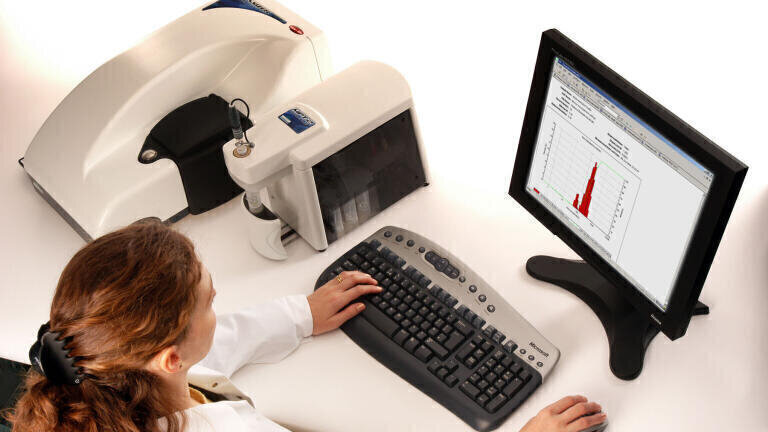
The Zetasizer Nano ZS measures particle and molecule size from less than one nanometer up to several microns using dynamic light scattering, zeta potential and electrophoretic mobility using electrophoretic light scattering, and molecular weight using static light scattering.
ILM 51.6 Sept 2026

 Product directory