Clean Room
Published over 11 years ago. See the latest and most current information on Clean Room.
Good technique when working within a Class II Biological Safety Cabinet (BSC) will minimise air turbulence and prevent splatter or unwanted spread of aerosols. Here are some tips for good techniques that will maximise potential protection of personnel, product and environment.
Tip 1: Know your Airflow
Biological Safety Cabinets provide personnel, product, and environmental protection through the use of HEPA Filtered air. Knowing how the air is passed through the cabinet an essential piece of the puzzle to know.
Tip 2: Work at the Proper Sash Level
Proper airflows are reached by a certifier measuring air speed on an annual basis (or more) to put a stamp of approval that the cabinet is fully operation to provide personnel, product, and environmental protection.
Tip 3: Never Cover the Air Grill
Covering the air grill at the front of the cabinet compromises airflow integrity; can cause laboratory air to enter the work zone or even work zone air to enter the laboratory environment.
Tip 4: Minimise Movement
The rapid movement of a worker’s arms in a sweeping motion into and out of the cabinet will disrupt the air curtain and may compromise the partial barrier containment provided by the BSC. Other personnel activities in the room (e.g. rapid movement, open/closing room doors etc.) may also disrupt the cabinet air barrier.
Tip 5: Reduce Splatter
Many common procedures conducted in Biological Safety Cabinets may create splatter or aerosols. Good microbiological techniques should always be used when working in a Biological Safety Cabinet to minimise this splatter, aerosols, and the-potential for personnel exposure to infectious materials manipulated within the cabinet.
Tip 6: Know Your Work Area
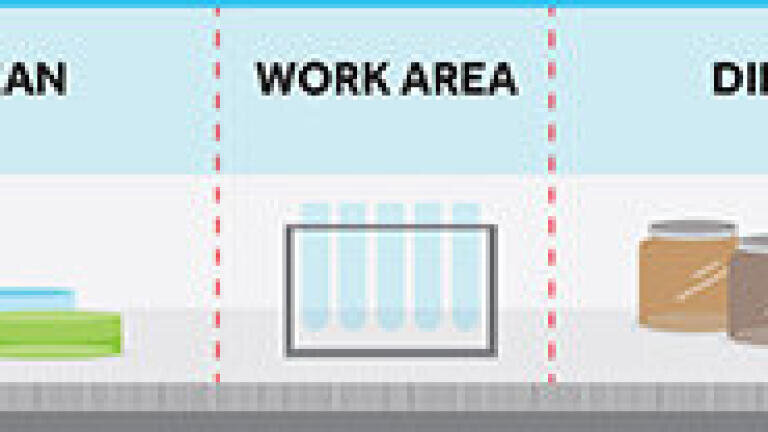
The middle third of the work surface is the ideal area to be used. All operations should be performed at least four inches from the front grille on the work surface. Materials or equipment placed inside the cabinet may cause disruption to the airflow, resulting in turbulence, possible cross-contamination, and/or breach of containment.
Tip 7: Work form Clean to Contaminated
Active work should flow from the clean to contaminated area across the work surface. Materials and supplies should be placed in such a way as to limit the movement of 'dirty' items over 'clean' ones. All materials should be placed toward the rear edge of the work surface and away from the front grille of the cabinet to take advantage of the air split.
Tip 8: Working with Tubes
Open tubes or bottles should NOT be held in a vertical position. Bottle or tube caps should not be placed on the toweling. Items should be recapped or covered as soon as possible.
Tip 9: Working with Petri Dishes
Investigators working with Petri dishes and tissue culture plates should hold the lid above the open sterile surface to minimise direct impaction of downward air.
Tip 10: Working with Aspirator Bottles or Suction Flasks
Aspirator bottles or suction flasks should be connected to an overflow collection flask containing appropriate disinfectant, and to an in-line HEPA or equivalent filter.
To learn more visit the webiste.
ILM 51.6 Sept 2026




 Product directory















.jpg)
.jpg)
-(1).jpg)