Electron
Researchers in Beijing have connected an AI system to a focused ion beam microscope to plan and run steps of TEM sample preparation, though lift-out remains unsolved.
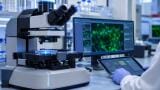
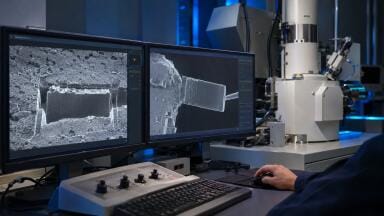
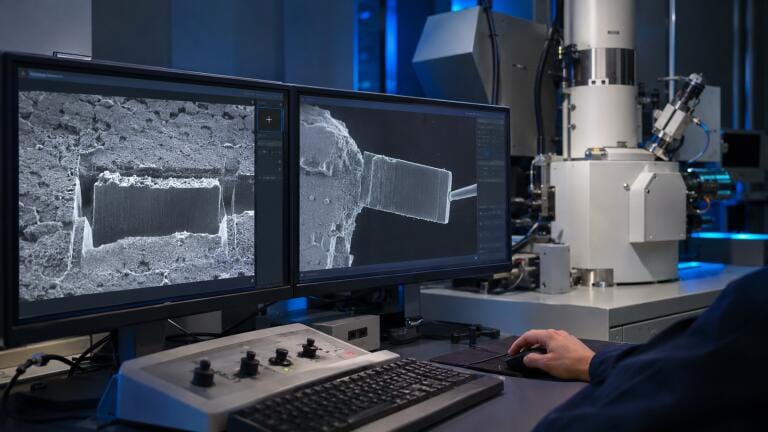
A research team in Beijing is developing an AI framework that operates a focused ion beam scanning electron microscope (FIB-SEM) to prepare lamellae, the thin specimens used in transmission electron microscopy (TEM).
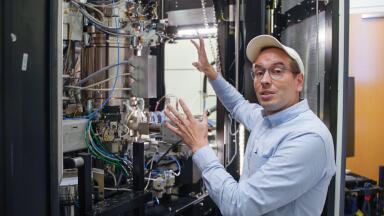
The Hyper-FIB framework was developed by the AI for Science Institute, Beijing (AISI), DP Technology and Xiaoxu Zhao’s research group at Peking University. It was described in an interview with Dr Zezhong Zhang, Head of the Advanced Characterization Division at AISI, published by Tescan on Monday, 23 November 2026.
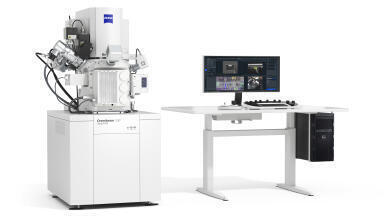
The system connects to a Tescan SOLARIS FIB-SEM at Peking University through the manufacturer’s application programming interface (API), giving software access to stage movement, image acquisition and alignment. It interprets the user’s objective, schedules microscope operations and analyses images, with each observation feeding into the next decision.
Lamella preparation is a demanding test because each step depends on the last. According to the interview, the framework covers localisation, marking, calibration, deposition and rough and fine ion-beam milling. Lift-out and final polishing are still under development and validation.
Zhang said imprecise positioning of the manipulator needle, or weak attachment, can cause lift-out to fail. Maintaining reliable image interpretation over long procedures remains a central challenge.
“I wouldn’t say that we fully solved it yet,” he said of the vision problem.
An earlier version used a large language model interface. When a Tescan expert tested it, Zhang said: “Some requests worked, while others were misinterpreted.”
The interview reports no success rates or processing times, and does not cite a peer-reviewed publication for the framework.
Automated lamella preparation is already offered commercially, with vendors running recipe-based workflows. The Hyper-FIB work differs in aiming for adaptive experiments, where the system decides its next step from what it observes rather than following a fixed recipe.
Lab Asia 33.6 Dec


 Product directory