Electron
Researchers have achieved a 4.4 Å cryo-electron microscopy reconstruction of the giant Melbournevirus capsid, with a block-based approach that reveals protein organisation and informs viral evolution and nanomaterial design
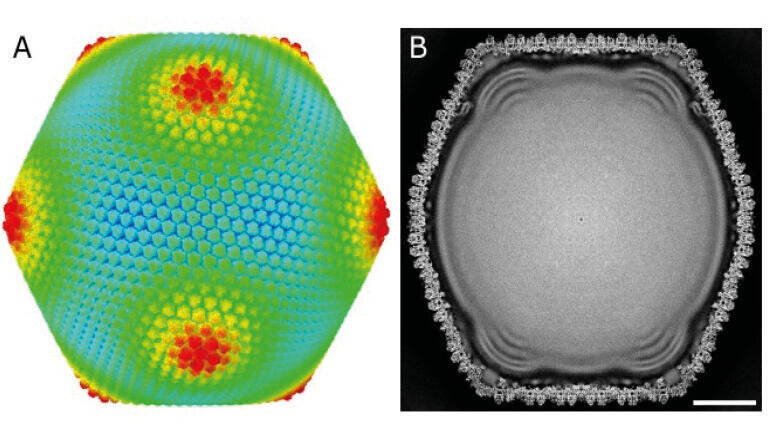
A research collaboration led by Professor Kazuyoshi Murata at the Exploratory Research Center on Life and Living Systems, part of the Japanese National Institute for Physiological Sciences, Okazaki, Japan, has determined the capsid structure of Melbournevirus at 4.4 angstrom resolution using cryo-electron microscopy.
The work, undertaken with Senior Researcher Kenta Okamoto at Uppsala University, Sweden, and Professor Chantal Abergel at Aix-Marseille University, France, has marked the first time that the outer shell architecture of this giant virus has been resolved at this level of structural detail.
Melbournevirus belongs to the group of so-called giant viruses, which possess unusually large genomes and particle sizes that approach those of small cellular organisms. Its capsid – approximately 250 nanometres in diameter – represents a highly ordered macromolecular assembly constructed from a limited repertoire of viral proteins.
To resolve this complex architecture, the team has applied a block-based reconstruction method to cryo-electron microscopy image datasets. This computational strategy partitions the viral particle into smaller regions, which allows refinement at a local level and reduces the impact of structural heterogeneity. The result has been a substantial improvement in the resolution of the three-dimensional reconstruction compared with conventional whole-particle approaches.
At 4.4 angstrom resolution, the analysis has enabled the researchers to define the spatial arrangement and interactions of capsid proteins with a high degree of precision. Such resolution permits the identification of secondary structural elements and provides insight into how repeating protein units assemble into a stable and geometrically consistent shell. The findings have clarified how a relatively small number of protein species can generate a large, mechanically robust structure with strict symmetry and uniformity.
The implications extend beyond structural virology. By elucidating the design principles that underpin the assembly of large viral capsids, the study has provided a framework to understand how complex biological nanostructures evolve and maintain stability. Giant viruses such as Melbournevirus occupy an important position in discussions of viral evolution, as their genetic and structural features blur traditional distinctions between viruses and cellular life. Detailed structural data therefore support efforts to reconstruct evolutionary pathways and to interpret how these entities interact with host cells during infection.
The work also has translational relevance. The capsid architecture of giant viruses has attracted interest as a template for engineered nanomaterials, particularly in the context of inclusion compounds and targeted drug delivery systems. The ability to resolve protein organisation at near-atomic detail has the potential to inform rational design strategies, where viral capsids or capsid-like particles are repurposed to encapsulate therapeutic payloads or to deliver them with high specificity.
By combining methodological innovation with high-resolution imaging, the study has established a benchmark for structural analysis of large viral assemblies. It has demonstrated that block-based reconstruction can overcome longstanding technical barriers associated with particle size and complexity, and it has opened a route to interrogate other giant viruses with comparable precision.
For further reading please visit: 10.3390/v18040433
ILM 51.6 Sept 2026



 Product directory


.jpg)
.jpg)























.jpg)
