Laboratory products
Published over 16 years ago. See the latest and most current information on Laboratory products.
AMSBIO have announced a range of ready-to-use lentivirus supernatant products suitable for many kinds of gene delivery applications including stem cell research.
Converting fully differentiated mouse or human somatic cells into embryonic-like cells (so called induced Pluripotent Stem Cell: iPSC) has attracted enormous attention in stem cell research. Multiple reports have demonstrated that IPS cells were generated by using a set of transcription factors or stem cell factors that delivered as expression virus or expressed proteins. Although the combination of reprogramming factors may slightly different, the main stem cell factors are: OCT3/4, SOX2, NANOG, LIN28, c-Myc and KLF4. iPSC holds the promise of curing many human diseases and accelerates the stem cell research.
Using the SureTiter™ lentiviral system from AMSBIO, you can generate high-titer lentiviral particles for all six human stem cell factors. Each factor was fully sequencing verified and matched to the CDs in NCBI database. High titer lentiviral particles/supernatant were produced in 293T packaging cells in DMEM with 10% heat-inactivated FBS. They are psudotyped with VSV-G glycoprotein-attached vector map.
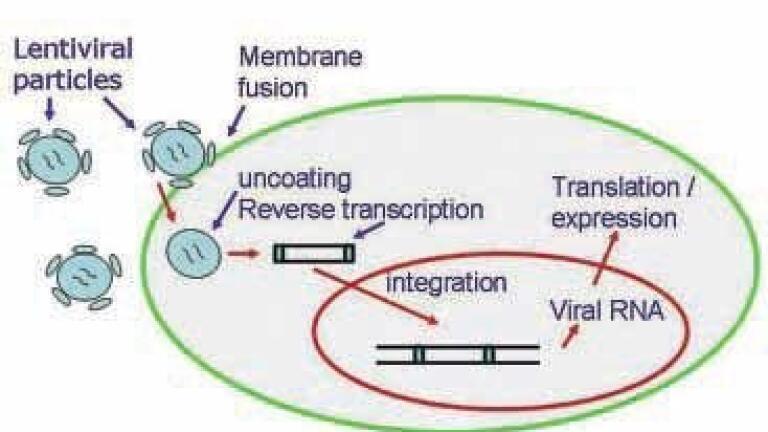
The AMSBIO lentiviral system is a gene delivery tool using lentivectors for gene expression or knockdown. Lentivirus can effectively transduce both dividing and non-dividing mammalian cells, and integrate into the host genome, allowing stable long-term, high-level gene expression both in vivo and in vitro.
Unlike traditional retroviral system, AMSBIO lentivirus is much more actively imported into the nuclei of non-dividing cells and stably integrated into the host cell’s genome independent of cell cycle. Although adenovirus is
also able to transduce non-dividing cells, it is only for transient expression because it cannot integrate into host cell’s genome.
ILM 51.6 Sept 2026


 Product directory