Laboratory products
Published over 5 years ago. See the latest and most current information on Laboratory products.
In new case studies, we highlight QA and raw materials screening for chemical suppliers to the plastics and construction, fluoropolymers and lithium ion battery industries. Developments in benchtop NMR are now delivering significant cost and time savings for both low volume and high throughput uses.
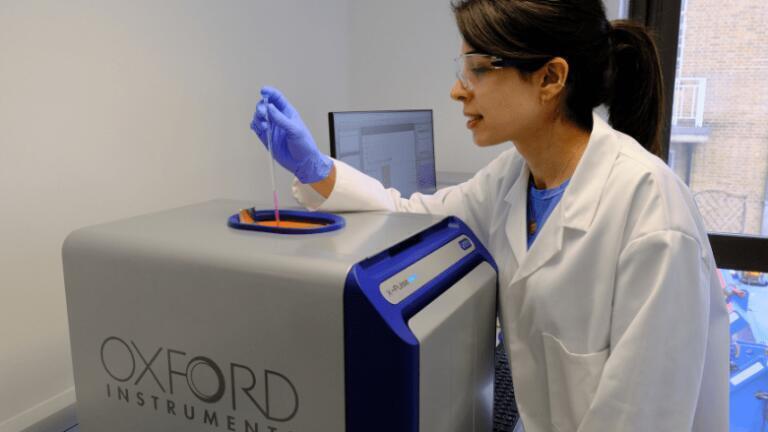
NMR spectroscopy is an analytical technique familiar to most chemists working in industry and academia, and is a vital part of today’s chemistry, biochemistry, food and pharmaceuticals research. NMR enables fast identification of most organic substances by determining their chemical structure and can often quantify the amount of a specific substance in samples. Benchtop NMR spectrometers use permanent magnets instead of the cryogen cooled superconducting magnets used in high field NMR instruments. They are consequently much smaller, easier to maintain and cheaper to run and can take over routine work previously carried out using high field NMR instruments or complementary analytical techniques (e.g. FTIR, NIR, GC-MS and some chromatography techniques). Instruments can be placed in a laboratory or test facility and can also be moved on a trolley to different factory locations. This now makes benchtop NMR spectroscopy an ideal technique for Quality Control (QC) of raw materials, for in line process monitoring and end product Quality Assurance (QA).
Most analytical work on benchtop NMR spectrometers uses just the proton (1H) spectrum, but benchtop instruments are perfectly capable of obtaining spectra from other NMR-sensitive nuclei including carbon (13C), fluorine (19F), phosphorus (31P), lithium (7Li), boron (11B), silicon (29Si), and many others. The X-Pulse instrument offers a broadband option where a large range of NMR-sensitive nuclei can be accessed on a single instrument. Benchtop NMR spectrometers typically work best for identifying molecules or compounds with molecular weights around 600 Daltons or less. In this range, the peaks in the spectra can be quantified by lower dispersion benchtop systems.
A common application for benchtop NMR is fast screening of samples to confirm molecular structure after a chemical synthesis. This provides a QA tool, to check the quality and identity of incoming raw materials. They can additionally check large numbers of samples quickly to see whether the expected peaks are present in the spectrum before passing the samples on to high field systems for more detailed analysis. This saves considerable time for the chemists doing the syntheses and makes sure that the expensive high field instruments are used in the most efficient way.
To read the full article including case studies, visit our website.
ILM 51.6 Sept 2026




 Product directory