Laboratory products
Trilobio, a developer of whole-laboratory automation solutions, has introduced the first version of its integrated robotics, lab equipment, and software platform. Early pilot data highlights its ability to enhance research workflows by improving efficiency, data quality, and reproducibility.
Founded to advance genetic engineering, synthetic biology, and life science research, Trilobio has built modular robotic lab automation with an integrated application store for packaging and distributing lab protocols as code. By automating entire lab workflows, the company addresses critical issues in research reproducibility, with studies estimating that 77% of biologists struggle to replicate their own or others’ experiments, despite existing automation tools.
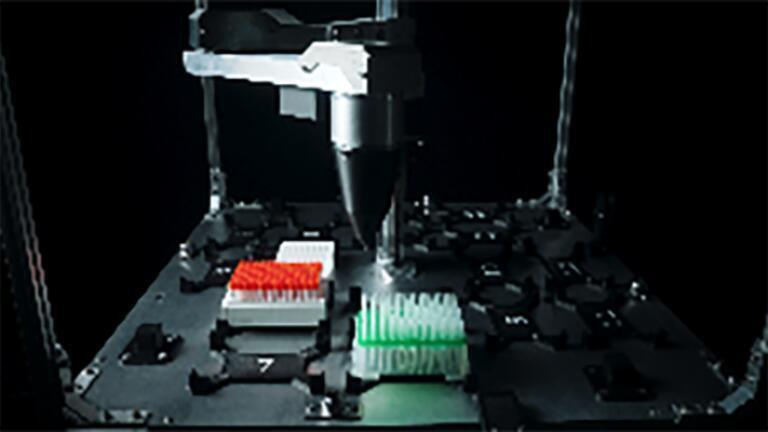
The Trilobio platform includes the Trilobot lab robot, research devices (grippers, pipettes, and tube handlers), and Trilobio OS, a research protocol software designed to ensure reproducibility across all Trilobio-enabled labs. By automating whole-lab operations, Trilobio helps researchers maximise efficiency, accuracy, and reliability while reducing the cost and complexity of adopting automation.
At the core of the platform is Trilobot, a multifunctional robot built on standardised hardware and software, allowing seamless operation of any Trilobio research tool. Multiple Trilobots can collaborate to scale up experiments. Trilobio OS serves as the platform’s software engine, integrating protocol design, optimisation, and execution with an automated lab notebook and LIMS. Researchers can create advanced protocols using a no-code graphical interface instead of machine code, making automation more accessible. The system also optimises protocols for speed, cost, or accuracy automatically.
By combining standardised hardware and innovative software, Trilobio ensures that protocols executed on its platform, are fully reproducible across any configured Trilobot system, without recalibration or rewriting.
More information online
ILM 51.6 Sept 2026



 Product directory





















.jpg)
