Microscopy & microtechniques
Published over 14 years ago. See the latest and most current information on Microscopy & microtechniques.
Researchers in Texas have made significant advances in the treatment of spinal and brain injuries by discovering how spinning microparticles can direct the growth of nerve fiber.
The study, based on Samarendra Mohanty's hypothesis that neurons can respond to physical (e.g. fluid flow) cues in addition to chemical cues, could allow for directed growth of neuronal networks on a chip, which would improve certain medical methods.
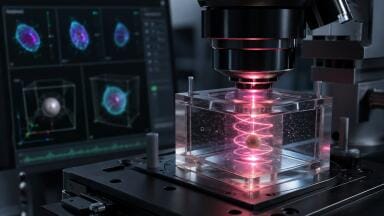
The laser-driven spinning calcite microparticle caused a shearing effect by creating a microfluidic flow, which could guide the direction of neuron growth.
This is a significant advancement, demonstrating that microfluidic flow can turn neurons in a controlled manner, something that hasn’t been achieved previously. Using this method, it is possible to turn neurons left and right and quickly insert or remove the rotating beads as needed. The method can also be used to funnel growth between two rotating particles.
Authors of the paper, Michael Berns and Samarendra Mohanty, commented: "One can envision large arrays of these devices that can direct large numbers of axons to different locations.
"This may have the potential for use in vivo to direct regenerating axons to mediate brain and spinal cord repair."
ILM 51.6 Sept 2026





 Product directory