Atomic-level imaging is the
latest microscopy development to be achieved by scientists at the University of California - Los Angeles.
The researchers explain that an angstrom is the smallest recognised division in any chemical element and is broadly equivalent to the distance from one hydrogen atom to another in a molecule of water.
Using the
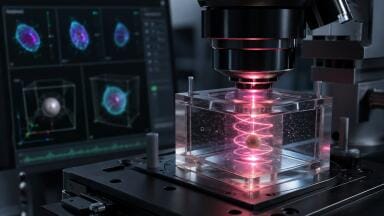
latest microscopy technology - which uses cryo-electrons to image at levels previously unachievable - objects 3.3 angstroms across can be pictured.
Xing Zhang, lead author of a paper on the project for the journal Cell, says: "This is the first study to determine an atomic resolution structure through cryo-electron microscopy alone.
"By proving the effectiveness of this microscopy technique, we have opened the door to a wide variety of biological studies."
The technology was used by the researchers to image a virus - the first time such a resolution of microscopy has been published.
In April, the university also revealed that it had successfully created the smallest and lightest microscope ever devised for telemedicine applications, which uses an LED and a sensor in place of a traditional lens to resolve images.






 Product directory