
Mixers
Silverson Machines recently visited Holiferm’s R&D laboratory in Manchester, where their team formulates personal care products around their own naturally derived biosurfactants and sophorolipids.
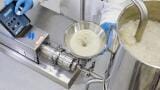
Application Scientist Clarissa Clark talked Silverson Technical Sales Engineer James Cardus through her cleansing lotion formulation and demonstrated the results of using a Silverson High Shear Laboratory mixer for processing in comparison to a standard overhead stirrer, checking the results under the microscope.
The cleansing lotion formulation was developed using Holiferm's LF and HF sophorolipids, selected for their complementary hydrophilic-lipophilic balance (HLB) values of 11 and 17 to match the requirements of the oil phase. Beyond providing emulsion stability and effective cleansing, the naturally derived biosurfactants also contribute microbiome-friendly and skin barrier-supporting properties.
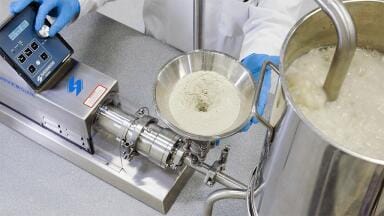
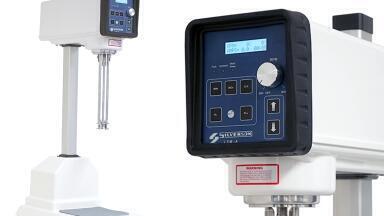
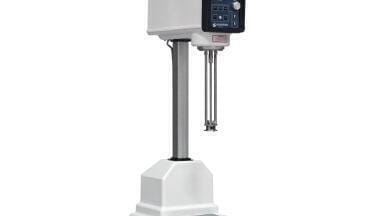
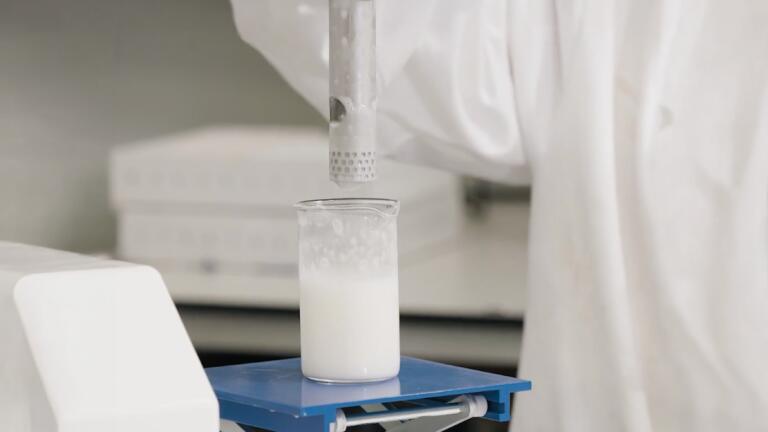
After combining the water phase with the oil phase, the mixture was split into beakers and processed under both a Silverson L5M-A High Shear Laboratory mixer and a standard overhead stirrer.
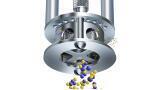
Initially, the overhead stirrer looked to have incorporated the water phase into the oil phase, but there was a contrast in the colour of the mixture compared to the emulsion produced by the Silverson. Processing the same formulation with the Silverson high shear mixer the emulsion almost instantly developed a brighter, whiter appearance, an indication that particle size had been significantly reduced.
Although both mixing methods appeared to the naked eye to have combined the phases and created an emulsion, the differences in the quality of these emulsions would become apparent once the samples were looked at under the microscope.
The results from the Silverson Laboratory mixer showed a tightly compact, homogeneous mix of oil and water with small and uniform droplet size. This even droplet size distribution throughout the sample confirmed it was a stable emulsion.
The overhead-stirred sample told a very different story. Under the microscope the stirrer sample showed a broad range of droplet sizes, with much larger droplets dispersed among smaller ones. This sample lacked the fine dispersion needed for long-term stability. Larger oil droplets remain more prone to coalescence, increasing the likelihood of separation during storage and reducing product consistency over time.
The stability of the emulsion in products like cleansing lotions and other personal care items is not only important for the subsequent processing steps, but for the consumer once they take the product home. A stable emulsion will allow the product to remain on a consumer’s shelf for a prolonged period of time, performing as it did on day one, without the emulsion separating.
The comparison illustrates why high shear mixers are superior to conventional methods of mixing when it comes to create fine, stable emulsions.
See the video on the Silverson website.
More information online
ILM 51.6 Sept 2026




 Product directory