News
Published over 9 years ago. See the latest and most current information on News.
Since its discovery in 1967, Comet 67P/Churyumov-Gerasimenko has been infatuating space scientists. A Jupiter-family comet originally from the Kuiper belt, little else was known about the icy small Solar System body, except for that it has an orbital period of 6.45 years, and a rotation period of 12.4 hours.
Now, scientists have made an exciting new discovery, confirming for the first time that Comet 67P/Churyumov-Gerasimenko contains traces of simple amino acid glycine, as well as the chemical element phosphorous. Both are two essential building blocks of life, and their presence suggests that comets may have played a keynote role in bringing life to planet Earth.
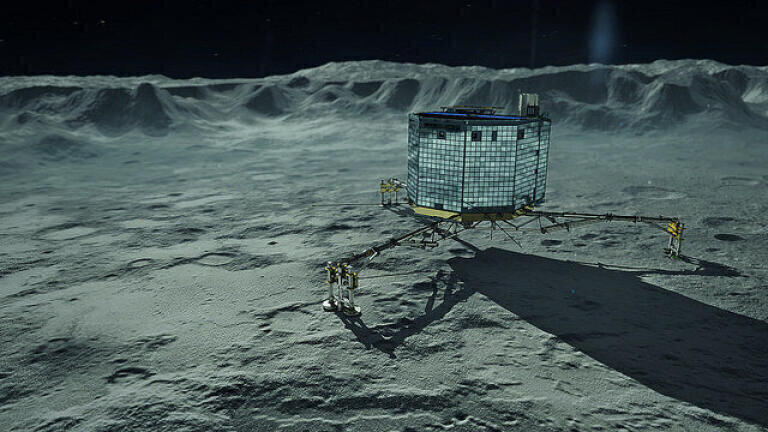
The new findings were made by the ESA, on-board its Rosetta spacecraft. The discovery has already been published in the journal Science, and has raised a host of new questions and suspicions regarding the origins of life on Earth.
“You would need 10 million comets to supply Earth’s water, but only a few hundred to supply the organic material,” explains Kathrin Altwegg, the study’s lead author. “It’s not proof they started life on Earth, but certainly if you start from amino acids, you could make life. And we know that comets impacted Earth.”
So how did the team track down traces of glycine and phosphorous? On-board Rosetta is an advanced piece of equipment called ROSINA. Scientists used this to actively detect and sort gas molecules in the comet’s coma when the craft made its closest approach back in August 2015. As a biologically important organic compound found in proteins, glycine is an essential component of life. Similarly, phosphorous, plays a keynote role in the structural framework of RNA and DNA.
“This shows that comets had the potential to deliver organic-rich material throughout the Solar System, in particular Earth,” says Rosetta project scientist Matt Taylor. “The combination of such a delivery with a water-rich environment like Earth then provides the next step to the formation of life itself.”
As well as helping scientists understand how life on Earth came to be, the presence of organic compounds in comets has raised questions as to whether or not the same process could have unfolded elsewhere in the universe…
“What could have happened to Earth could have happened everywhere,” said Altwegg.
Today, phosphorus is an integral part of plant and animal life on Earth. For more information on the role it plays in global ecosystems, ‘Investigating Phosphate Starvation in Plants Using Bioluminescence’ explores the need for optimising crop growth, and minimising costs.
DLR German Aerospace Center
ILM Guide 2026/27

 Product directory