News
Published over 10 years ago. See the latest and most current information on News.
When Caltech’s Dr. Michael Brown demoted Pluto from its planetary status, he sparked global controversy with space scientists and school teachers alike. Clearly he wasn’t too ridden with guilt, as he went on to christen his Twitter account @plutokiller. Here’s to a scientist with a sense of humour.
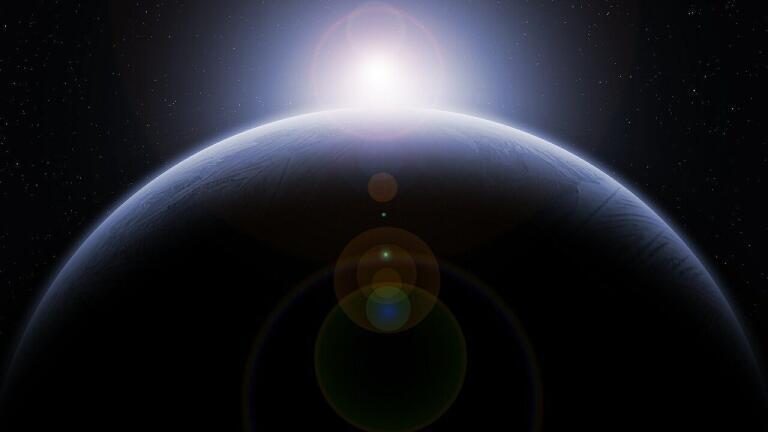
Now, the infamous Professor of Planetary Astronomy is attempting to reverse his reputation as a solar buzzkill and officially name a new planet. With evidence mounting, the discovery of Planet Nine is looming.
Visual confirmation has yet to emerge, but Brown and his team are confident that the hypothesised planet does exist. He first put forward his theory in January, maintaining that its elongated orbit has the power to disturb comets and dwarf planets that cross its path. According to Brown, planets orbiting the outer Solar System show signs of ‘herding’ by a mass that’s similar in size to Neptune.
The theory was strengthened with the recent discovery of a SETI colloquium of a Kuiper Belt Object (KBO). Noting an orbit of 30-50 astronomical units (AU), Brown excitedly tweeted “Hey Planet Nine fans, a new eccentric KBO was discovered. And it is exactly where Planet Nine says it should be.”
Examples of gravitational shepherding have also been recorded in six other KBOs, all approaching the Sun on the same side. This is despite significant differences in orbital lengths, which Brown considers further proof that Planet Nine exists. The same concept was used to hone in on Neptune, and also led to the discovery of planets that exist beyond the Earth’s Solar System.
With evidence quickly mounting, space scientists are eagerly putting together their own Planet Nine theories. Swiss astrophysicists Esther Linder and Christoph Mordasini are two of the first high profile professionals to put forward their own notions, maintaining that the mysterious planet is 10 times bigger than Earth, and 3.7 times its radius. They also claim it radiates infrared light, which means that Chile’s Large Synoptic Survey Telescope is the most promising technology capable of sighting the planetary object.
The latest Planet Nine theories prove that in space, not everything is as it seems. The same concept applies to laboratories on planet Earth, with ‘Pipette Service & Calibration - A Guide to Accurate and Reproducible Results’ introducing readers to the issue of pipette failures. With 95% of incidents not detected, it’s critical to select a reliable and trustworthy service provider. Ultimately, this will save time, save money and minimise liability.
Lab Asia 33.4 - August 2026

 Product directory