News
Published over 10 years ago. See the latest and most current information on News.
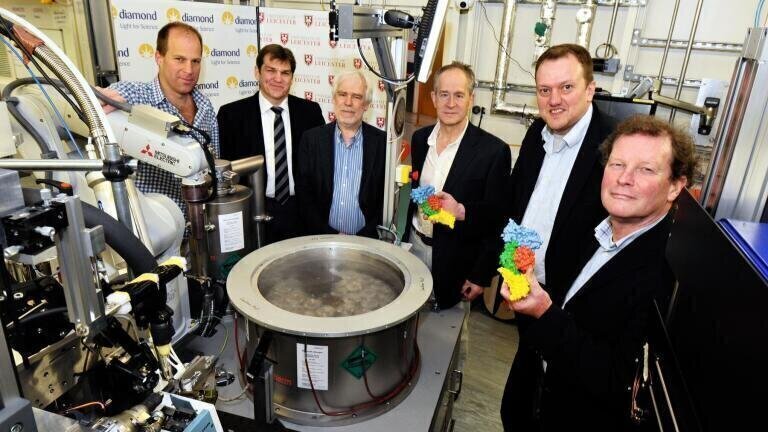
Diamond Light Source – the UK’s national Synchrotron– is now able to offer scientists a world-first facility that will accelerate the process of developing novel compounds for drug discovery.
Prof Dave Stuart, Diamond’s Director of Life Sciences and Head of the Division of Structural Biology in the Department of Clinical Medicine at the University of Oxford, comments: “Scientists are using Diamond to study a wide range of viral and bacterial infections, along with cancer, heart disease, diabetes and neurodegenerative conditions such as Alzheimer’s and Parkinson’s. While great progress is being made, on average it still takes at least ten years for a new medicine to complete the journey from initial discovery to the marketplace. Having a facility like XChem at the synchrotron is therefore a major step forward, allowing scientists to evaluate the equivalent of millions of compounds using just a few hundred much smaller compounds (named “fragments”). We believe it will give a particular boost to the combat of neglected diseases, where non-commercial research plays a major role, thereby greatly amplifying the impact of making available cutting-edge drug discovery technology.”
XChem harnesses synchrotron X-rays so that fragments can be directly observed interacting with the target protein. Structural biologists can therefore identify where drugs could potentially bind and target that particular area for further research. New technologies developed at Diamond and in partnership with the Structural Genomics Consortium at Oxford University can also deliver unprecedented performance, making it possible to support a wide user base.
Dr Frank von Delft, jointly head of the XChem facility and the partnering lab at Oxford University, remarks, “It is only a world-class national synchrotron like Diamond that makes such a facility conceivable, and it is its strong collaborative links with the UK’s universities that then leads to the creation of next-generation technologies like XChem.”
Life sciences minister, George Freeman MP comments: “This development from Diamond shows the UK punches above its weight in the field of structural biology. The techniques on offer at XChem will save both time and money by swiftly identifying the most promising drug targets before more in-depth research takes place. This will help drive innovation in vaccine design, and the prevention of antibiotic resistance.”
Lab Asia 33.4 - August 2026
 Product directory
















.jpg)
,-G.-von-de-Kerkhof-(Diamond),-M.-Schuster.jpg)