News
Published over 7 years ago. See the latest and most current information on News.
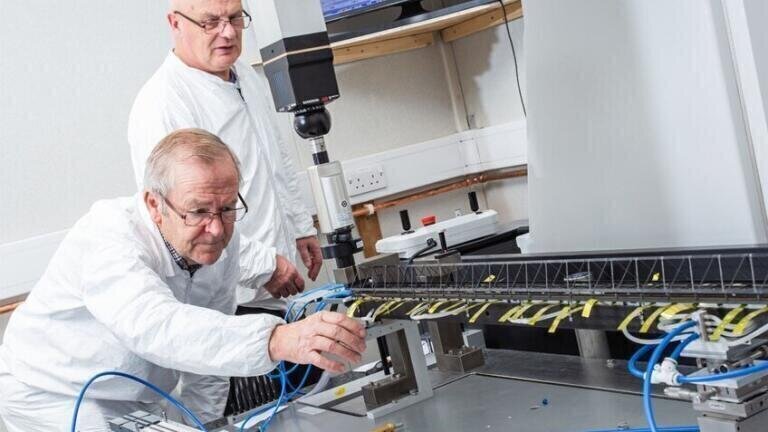
A team of scientists, engineers and technicians from Daresbury Laboratory, in collaboration with the University of Liverpool, have been playing a key role in developing and building ground-breaking new technologies that will enable a major upgrade of the ALICE experiment, one of the four main detectors at the Large Hadron Collider at CERN.
ALICE acts like a giant microscope that is used to observe and study a state of matter that was last present in the universe just billionths of a second after the Big Bang. The LHC is used to create this matter, by accelerating and then colliding heavy nuclei of lead.
Extremely thin and highly-pixelated sensors, together with ultra-light support structures will boost the tracking performance of ALICE by a factor of a hundred. It will be the thinnest, most pixelated tracker at the LHC, capable of identifying and measuring the energy of particles created by the LHC’s collisions at lower energies than any of the other LHC experiments.
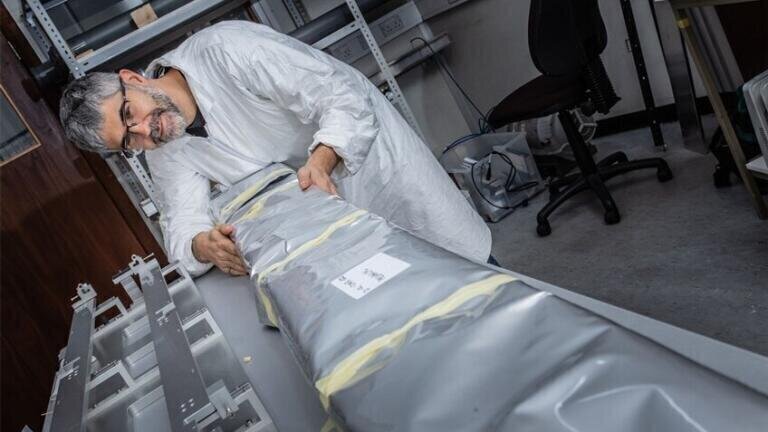
The Daresbury-Liverpool team is building 30 staves of this new generation of sensor, each containing millions of pixels. The staves, which frame and support the sensors, are now being carefully transported to CERN in batches every six weeks until the end of September, where they will be tested before being installed, officially making ALICE a billion pixel detector
Dr Roy Lemmon, physicist and lead for the ALICE upgrade project at STFC’s Daresbury Laboratory, which is located at Sci-Tech Daresbury, said: "This project highlights the skills and significant role of the UK’s researchers in the development of new generations of technology for, in this case, ALICE, part of the world’s largest science experiment. It’s very exciting to be part of something that will not only help solve our science challenges, but which could also impact our lives in a really positive way, such The ALICE upgrade is taking place during the scheduled two-year shutdown for the LHC. The newly-upgraded experiment will start taking data in 2021.”
ILM 51.6 Sept 2026


 Product directory


.jpg)
.jpg)