News
Published over 12 years ago. See the latest and most current information on News.
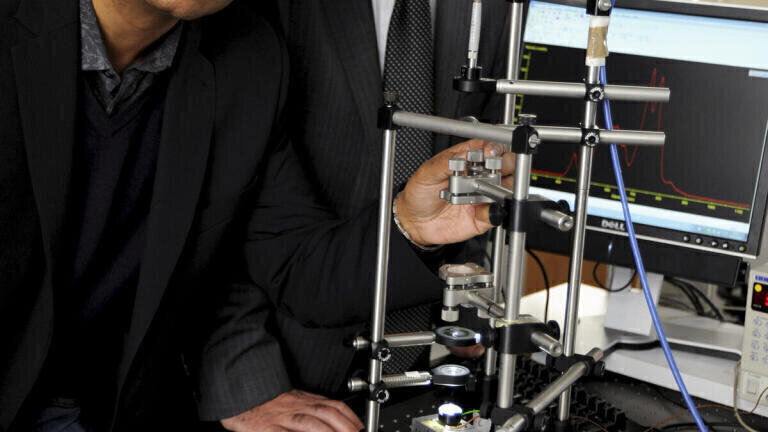
Academics at Teeside University are leading research with potential to dramatically reduce the amount of time it takes to diagnose patients at risk of developing sepsis, one of the most common causes of death in hospitalised patients, which could also save healthcare service sacross the globe billions of pounds. The £1.3 million CE-microArray project, which includes eight other European academic and SME partners, plans to use cavity enhanced absorption spectroscopy to improve the sensitivity of blood tests which are based on the absorption of light, by passing light many times through the sample.
In conjunction with the development of a more reliable biomarker panel for the diagnosis of sepsis risk, which will be undertaken by academic partners at the University of Freiburg and the University of Ulm in Germany, this could lead to a test which could be up to 100 times more sensitive than conventional testing.
The project is being carried out under the EU Seventh Framework programme (FP7) and is being coordinated by Dr Meez Islam, a Reader in Physical Chemistry in the School of Science & Engineering at Teesside University. One of the SME partners in the project is Anasyst, a company specialising in novel analytical systems which was spun out of Teesside University research. Dr Islam said: “At the end of this project, we hope to have novel ways of testing for sepsis which could have a massive impact across the world. We’ve seen that it can work in specialised cases and anything that can speed up the diagnosis times and start treatment earlier, even by a small amount, could potentially save thousands of lives each year.”
Professor Zulf Ali, the Dean of Teesside University’s Graduate Research School, and CEO of Anasyst, added: “This is an extremely prestigious project for Teesside University which could have enormous benefits worldwide. It showcases the high quality research which is done at Teesside and the way in which we can work with the healthcare industry to provide practical solutions to global problems.”
ILM 51.6 Sept 2026

 Product directory













.jpg)
,-photo-Karin-Allander.jpg)