News
Published over 6 years ago. See the latest and most current information on News.
An interdisciplinary centre for quantum science has been established by Paris-Saclay University, in partnership with several leading manufacturers and research organisations.
With major industrialists entering this field during the last decade, the mastery of these technologies are perceived by states as a crucial issue for their sovereignty; research by experts at the University has had significant impact, both at the national and international level in the discovery and development of specific properties such as quantum superposition, entanglement and control of individual quantum systems.
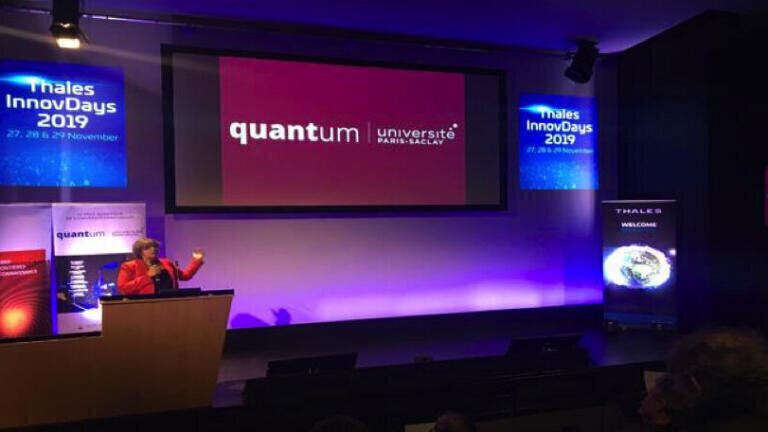
"The 40 research teams in our scope, most of which are the result of a close partnership with major organisations such as the CNRS, CEA and INRIA, represent more than 35% of the research effort in France, making Paris-Saclay University one of the cradles of the second quantum revolution at the highest international level. Equipped with state-of-the-art infrastructure and unique know-how in nanotechnologies and ultimate instrumentation, our activity has seen the rise of spintronics, the violation of Bell's inequalities, the first quantum communications, the first superconducting qubits and the emergence of mesoscopic physics," said Paris-Saclay University President Sylvie Retailleau, who was invited by Thales to its 2019 Innovation Days, where she announced the creation of QUANTUM.
All the laboratories in the Paris-Saclay area, whose know-how is based on the work of joint research units led by the CNRS, CEA and INRIA in particular, are the cornerstones of the field. They support the ambitions and actions of the centre, within higher education and research institutions (UPSud, UVSQ, ENS Paris-Saclay, Institut d'Optique Graduate school, CentraleSupélec) and national research organisations; a successful spin-out has been Quandela, suppliers of quantum light sources. Alongside them, major French and international manufacturers, Thales, Air Liquide, EDF Lab, ATOS and IBM, are already showing their support.
For further information please click here.
ILM 51.6 Sept 2026




 Product directory
























.jpg)