News
Published over 10 years ago. See the latest and most current information on News.
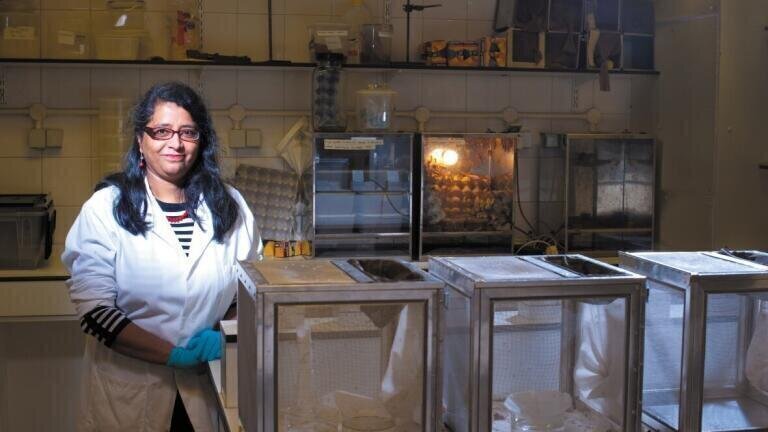
Professor Rita Tewari and Dr Bill Wickstead in Nottingham University’s School of Life Sciences have uncovered the role of cyclin - the protein molecule that drives the growth of malaria within mosquitoes. The research* describes the identification of three different types of cyclin in the parasite, followed by a more detailed analysis of the function of the ‘P-type’ cyclin which is closely related to cyclins found within plants.
It could help pave the way to better understanding of how the malaria parasite thrives within its insect and human hosts and lead to potential new treatments.
Lead author Dr Magali Roques, said: “This first functional study of cyclin in the malaria parasite and its consequences in parasite development within pathogen-carrying mosquitoes will definitely further our understanding of parasite cell division, which I hope will lead to the elimination of this disease in the future.”
Dr Bill Wickstead, who along with his master’s student Alexander Douglass characterised cyclin-like genes across Apicomplexa, said: “Cyclins are a really diverse class of proteins comprising many different types in different organisms. What’s interesting is that Plasmodium contains a really small set of unusual composition. It was clear that this was likely to be related to their unusual cell and life-cycles and Professor Tewari’s group was in a great position to be able to test this.”
The research also involved collaboration from the Francis Crick Institute, University of Oxford, King Abdullah University of Science and Technology in Saudi Arabia and University College London. It was primarily funded by the MRC and BBSRC to Professor Rita Tewari and Dr Bill Wickstead, with support for lead researcher Dr Magali Roques from an EMBO Long-Term Fellowship. Further financial support has came from CRUK, Wellcome Trust and EVIMalaR and KAUST.
*Plasmodium P-Type Cyclin CYC3 Modulates Endomitotic Growth during Oocyst Development in Mosquitoes is published in PLoS Pathogens.
Lab Asia 33.4 - August 2026
 Product directory