Mass spectrometry & spectroscopy
Analytical laboratories are under increasing pressure to deliver more results at an ever faster pace. Growing sample volumes, a persistent shortage of skilled personnel and rapidly expanding analyte lists are creating a significant productivity challenge. Driven by stringent new limits and broadening restrictions, laboratories must now navigate detection limits down to parts-per-trillion. This global push to regulate emerging contaminants adds complexity to routine workflows, forcing modern laboratories to deliver faster, more reliable results in a variable regulatory landscape.
To stay productive, laboratories need technologies that simplify method development, reduce rework and enable confident results without increasing operational burdens. Modern Inductively Coupled Plasma Mass Spectrometry (ICP-MS) platforms address these demands by shifting the operational burden from the analyst to the instrument, helping laboratories improve productivity and control cost per sample, achieving more with the resources already available.
Laboratories have primarily relied on traditional atomic spectroscopy techniques, notably Atomic Absorption spectrometry and Inductively Coupled Plasma-Optical Emission Spectrometry (ICP-OES). While these methodologies remain applicable for specific analytical tasks, ICP-MS presents distinct technical advantages. The primary benefit is its superior sensitivity with substantially lower limits of detection, achieving parts-per-trillion and even parts-per-quadrillion ranges.
ICP-MS also provides comprehensive, simultaneous multi-element analysis. ICP-OES can suffer from complex optical spectral overlaps, while an ICP-MS system can scan the vast majority of the periodic table yielding a relatively simple spectrum for quantitative analysis. This significantly increases laboratory sample throughput. Additionally, modern ICP-MS instrumentation exhibits a wide linear dynamic range. This characteristic permits the simultaneous measurement of both ultra-trace-level contaminants and high-concentrations of major elements within the same analytical run, reducing the need for manual sample dilution.
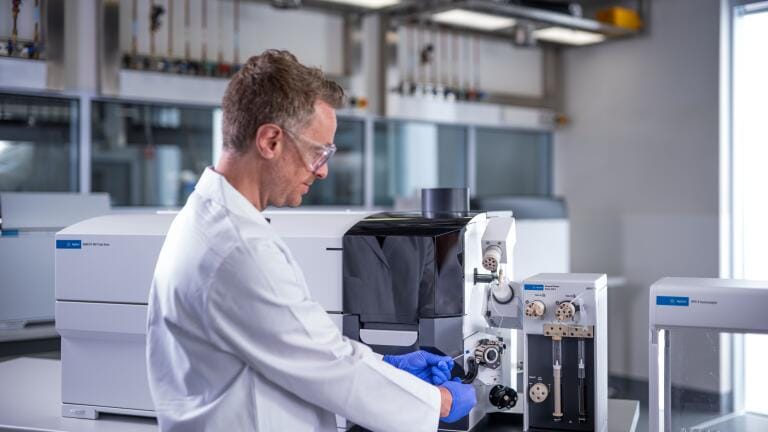
An ICP-MS system operates by introducing a liquid sample via a peristaltic pump into a nebuliser, where argon gas converts it into a fine aerosol. This aerosol passes through a spray chamber to filter out larger droplets before entering an argon plasma torch. Within the torch, electromagnetic fields generate a plasma discharge reaching temperatures of approximately 10,000°C, which rapidly desolvates, vaporises, atomises and ionises the sample.
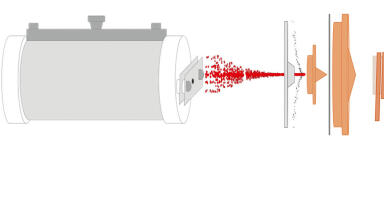
The resulting ions are drawn from atmospheric pressure into the mass spectrometer’s high-vacuum environment through a series of sampling and skimmer cones, where electrostatic lenses focus them into a beam. After passing through a collision/reaction cell to reduce spectral interferences, the ion beam enters a quadrupole mass filter that separates the ions by their mass-to-charge ratio. Finally, an electron multiplier detector records the ion impacts and translates them into electrical signals proportional to the elemental concentration of the original sample.
Choosing the right ICP-MS setup isn’t just a matter of chemistry. Instrument configuration directly dictates your lab’s daily sample throughput and your confidence in the results you deliver.
The core analytical challenge is managing spectral interferences. Background noise that can trigger false positives or inaccuracies in results. How an instrument resolves these interferences is the dividing line between standard efficiency and high-stakes precision.
For routine testing environments, the Single Quadrupole has been the standard for simple workflows. Modern Single Quads rely on a straightforward physical process – typically using a helium collision cell – to quickly filter out larger, slower-moving polyatomic interferences before they reach the detector.
This configuration is built for robustness and simplicity. It is highly effective for standard environmental, clinical and agricultural applications where sample matrices are well-understood and predictable. Given the system efficiently handles these routine matrices, your lab can maximise daily throughput. It requires fewer hands-on tasks, meaning your team spends less time interpreting complex data and more time turning around results and so keeping operational efficiency high.
When your lab takes on variable, complex sample matrices, or must meet strict trace regulatory limits, standard methodologies can fall short. Triple Quadrupole (ICP-MS/MS) technology solves this with a rigorous, multi-stage filtration process that isolates the target, uses reactive gases to chemically shift interferences out of the way, and detect only the analyte of interest.
Triple Quad systems are about risk mitigation and absolute data certainty. By eliminating false positives up front, you avoid the costly bottlenecks of re-testing and free your most experienced analysts from intensive manual data review. As a more advanced workflow, this approach can be relied upon to give accurate quantification even in the most variable and demanding sample matrices.
ICP-MS is especially valuable in laboratories where high sample volumes, complex matrices and low detection limits come together. In environmental testing, ICP-MS supports routine monitoring of drinking water, wastewater, soils and industrial discharges for trace and toxic elements, helping laboratories to maintain throughput as both analyte lists and reporting requirements expand.
For high-matrix samples such as seawater, brines, soils and digests, modern ICP-MS systems help reduce the need for extensive dilution and reanalysis. High-Matrix Introduction via aerosol dilution and a wide linear dynamic range enable laboratories to measure major and trace elements in fewer analytical steps, improving productivity while maintaining confidence in the result.
Within food safety and agriculture, ICP-MS enables the sensitive screening of contaminants such as arsenic, cadmium, mercury and lead across diverse sample types such as grains or seafood to spices and nutritional products. The ability to handle variable matrices with less manual intervention allows laboratories to reduce reruns and deliver reliable results across high-throughput testing programmes.
Pharmaceutical laboratories use ICP-MS for elemental impurity testing, where validated methods, low detection limits and consistent data quality are essential. Modern software-guided workflows and automated sample handling can help reduce method complexity and support routine compliance-driven analysis.
In semiconductor and high-purity chemical manufacturing, ICP-MS and ICP-MS/MS provide the ultra-trace sensitivity and advanced interference removal needed to detect contaminants at extremely low levels. For these laboratories, the value extends beyond sensitivity to confidence — avoiding false positives, reducing troubleshooting and protecting product quality.
Modern laboratories have been facing squeezes on productivity with short-staffing, rising sample volumes and a shortage of specialised expertise meaning labs can no longer rely on manual workflows for fear of errors. Automated ICP-MS technology directly addresses these bottlenecks, transforming human labour from tedious prep to high-value analysis.
In place of manual troubleshooting, auto-optimisation software can automatically configure nebuliser gas flow, plasma power and cell gases based on sample matrix inputs. This can lower the technical barrier for junior staff while securing data integrity.
To eliminate the bottleneck of highly concentrated samples, inline autodilution automatically detects over-range samples, dilutes them and re-runs them without analyst intervention. This minimises contamination risks and enables wholly unattended overnight operation.
Ultimately, by cutting back on the levels of manual intervention with streamlined, intelligent workflows, busy laboratories can efficiently manage high sample volumes, reduce human error and protect their bottom line.
ILM 51.6 Sept 2026




 Product directory














.jpg)