Laboratory products
Published over 4 years ago. See the latest and most current information on Laboratory products.
Ultra-Low Temperature (ULT) freezers are well known to be high consumers of energy. Holding set temperatures 90°C to 100°C colder than their environment will always require a significant amount of energy. One way to reduce ULT freezer energy consumption is to warm up the set temperature. By doing so energy consumption will be reduced from 18-34% depending on the model, age & condition of the freezer. When considering warming up their ULT freezers, some end users raise concerns that by taking such an action they may expose their samples/contents to unfavourable temperatures during their day to day operation.
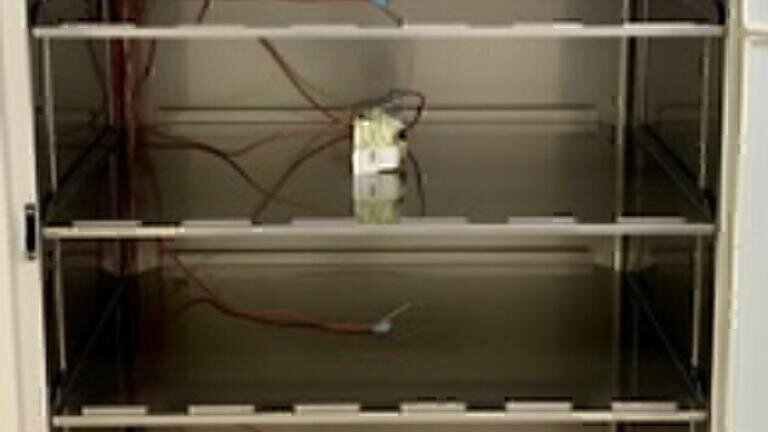
Previous studies have shown the use of racking can reduce temperature rises during door openings and increase the warm up times. Those studies like this study were jointly commissioned by Scientific Laboratory Supplies Ltd and Eppendorf UK, with racking kindly provided by Wesbart Ltd. This study set out to measure the temperature performance of Eppendorf’s F740hi freezer at four different set temperatures both with (Figure 1) and without racking (Figure 2).
This case study used the Logicall Wireless Monitoring system utilising their energy monitors, temperature probes and online platform to record all of the data. When measuring door opening recovery times this was determined when each individual probe returned to its mean temperature as measured at that temperature set point, door closed, over a 24-hour period. This is a more precise form of measurement which avoids warmer thresholds or average chamber temperatures to indicate recovery. In a similar way this was also the approach when measuring the warm up times to -50C, with each individual probe having its time to reach this threshold recorded. The probes were positioned as shown in Figure 1. The middle compartment (compartment 3) was also fitted with a sample probe which was immersed in 5ml of glycerol. The freezer was tested at the set points of -80°C, -75°C, -70°C and -65°C. The results are shown in figures 3 to 6.
From the data collected a number of observations can be made regarding the impact of racking. Firstly, adding racking alters the observed temperatures in each compartment. As shown in Figures 3-6, when racking is added to the freezer the temperatures in the top 3 compartments become 1-2°C warmer, whilst the temperatures in the bottom two compartments decreases by 1-2°C. The second effect of adding racking is the temperature variance inside each compartment is greatly reduced. This is reduced from 1.5-2.0°C to a maximum of 0.6°C with racking.
Figure 7. Warmest temperatures measured in the empty freezer set to -80°C (green) versus the racked unit which is at set temperatures 10°C warmer (blue) and 15°C warmer (yellow).
Racking also had a significant impact on the warmest (peak) temperatures recorded following a 60 second door opening. In the empty ULT freezer, at all the set points above -80°C a door opening resulted in temperatures warmer than -50°C being reached (see Figures 4-6). However, when adding racking, the temperature rises following a door opening were greatly reduced. Racking reduced the temperature rise following a door opening to a maximum of 4.0°C whilst in the non-racked units’ temperatures would rise by more than double this number in their ‘best compartments’ and over six times this number in the compartments most impacted by door openings (the top compartments). This impact is perhaps best summarised above in Figure 7.
As shown in Figure 7, warming the freezer up by 10°C and adding racking resulted in all but one compartments being colder following a door opening when compared to the -80C (empty) data. When the freezer is empty and at -80°C the top compartment probes came very close to breaching the -50°C threshold following a door opening. When testing the racked units, even at the -65°C set point those measured temperatures following a door opening were over 8C°C colder compared to the empty unit at -80°C.
The door opening recovery times in the empty freezer were generally faster compared to the racked unit. The exception being the bottom compartments of the racked units which, following a door opening actually fell in temperature due to the cold air cascading down from the upper compartments. These compartments aside, it is clear that for all compartments to recover from a door opening the racked unit will require ≥ double the time compared to the non-racked unit.
Similar to the door opening recovery times it was observed that with the exception of one probe at the -70C set point, that the warm up times to -50°C are double or longer with the addition of racking (Figure 8). The impact of racking on warm up times is clear when comparing the warm up times from the unit tested at -80°C empty to the racked unit tested at -70°C where the warm up times were between 30% to 98% longer.
Figure 8. Warm up times for the F740hi with and without racking at different set temperatures.
Special thanks to all those who made this study possible in particular:
Mr Neil Galloway-Phillips, Imperial College London.
Mr Josh Chapman, Scientific Laboratory Supplies Ltd.
Mr Richard McEwen, Eppendorf.
Mr David Patey, Wesbart Ltd.
Mr Ian Morris and Mr Tom Hunt, Logicall Wireless Monitoring.
For further information on this study, or lab sustainability in general please contact Andy Evans, [email protected]. Tel: 07833 494727
Lab Asia 33.4 - August 2026

 Product directory











-(1).jpg)


.jpg)



.jpg)