Laboratory products
Laboratories carry out an extraordinary range of work, and many of their processes rely on gases – from inert carrier gases used in analytical instruments to flammable or toxic gases needed for specialist research.
In these settings, gases or gas mixtures supplied in small canisters are typically used for niche or intermittent applications, such as calibration routines, method development, equipment validation or short-term research projects, where only limited volumes are required or where users wish to avoid the cost and logistics of full size cylinders.
Historically, these small quantities have been supplied in single use, hard to recycle canisters. And while this is not generally the primary supply method for routine, high volume laboratory operations, it nonetheless creates both environmental pressures and operational challenges.
When laboratories use significant numbers of canisters each year without return schemes or viable recycling pathways, storage areas can quickly become congested, creating a hazardous and space consuming problem. Indeed, partially used canisters are often retained for extended periods or stored as backup, increasing pressure on storage space and complicating inventory, tracking and end of life management.
As laboratories pursue more sustainable ways of working, rethinking how small supplies of gases are delivered is becoming an important area for innovation. Refillable canisters are now presenting a viable solution, supporting circular models that keep materials in use for as long as possible.
This change is largely driven by the potential efficiency and sustainability gains on offer, as laboratories look for ways to reduce energy use, limit waste and lower their carbon footprint. Safety considerations and tightening regulatory requirements are also prompting a fresh look at how gases are stored and managed.
Like all users of single-use gas canisters, laboratories have to comply with the Environment Agency’s conditions for the storage, depressurisation and disposal of single use canisters, with differing requirements depending on whether canisters are depressurised or not. In practice, this can involve designated storage areas for empty or partially used canisters, clear labelling and documentation, and coordination with specialist waste contractors. Moving away from single use canisters and towards refillable ones can enable safe and straightforward depressurisation on site, alongside swift collection, making it easier for laboratories to confidently comply with legal requirements.
Of course, canisters are not the only supply and storage solution on offer. Cylinders, for example, are ideal for long term applications or situations that require a continuous supply of gas. They are typically designed to hold larger volumes at higher pressure, and are refillable – but they are usually heavy and cumbersome to transport.
Canisters, on the other hand, are lightweight and portable, making them well suited to short term or specialist uses. Disposal, however, has long been a major drawback. Recycling single use canisters is often inconvenient, costly and energy intensive, with incorrect disposal leading to safety risks and potential penalties. As a result, empty canisters frequently end up being stored for extended periods or sent to landfill.
Refillable canisters are transforming the process by providing a simple but effective innovation that helps move from a linear to a circular model, maintaining the convenience of traditional canisters while reducing overall environmental impact.
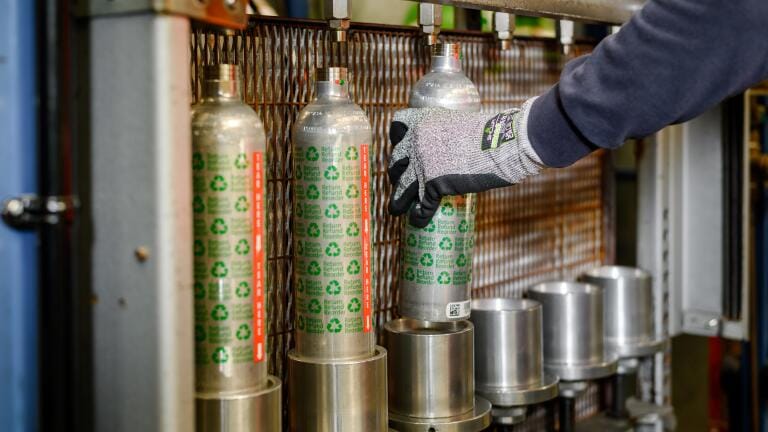
Air Products’ Experis® Eco canister range demonstrates this shift. By offering an end to end managed refillable system, it reduces waste, saves energy and removes disposal risks, helping laboratories work towards their sustainability targets without compromising performance or introducing additional administrative burden. It can also reduce the number of empty or partially used canisters held on site, supporting day to day housekeeping and routine inspections.
The return process is safe and simple. A specially designed keyway tool is used to depressurise canisters before a courier is arranged to return them. Each canister is then inspected, relabelled and refilled for reuse.
Critically, rather than ending at the point of purchase, the supplier’s responsibility extends to working with the laboratory to manage the full circular refilling system.
But what about the cost? While it is true that sustainable alternatives do not always reduce upfront expenditure, refillable canisters can significantly reduce hidden costs. Although aluminium is technically recyclable, single use canisters are often classified as contaminated and pressurised waste, requiring specialist handling and disposal arrangements that increase both cost and complexity for laboratories.
Refillable systems do not present the same challenges. Users return canisters through a straightforward process and receive credit on their account, rather than having to manage the costs and administration associated with safe storage, labelling and disposal of single use containers.
Future proofing means choosing technologies that are flexible, upgradeable and environmentally responsible. It also means recognising that choices around gas supply can have wider impacts, including on a laboratory’s risk profile, operational efficiency and environmental credentials.
By switching away from non recyclable canisters, laboratories can ease pressure on valuable space and reduce the burden associated with disposal. Refillable systems also support greener procurement and help laboratories operate more efficiently.
The conversation is moving beyond simply meeting today’s standards. It is about setting stronger safety, efficiency and sustainability benchmarks for the future, and using practical technological innovations to get there. Refillable canisters represent a positive step forward.
ILM 51.6 Sept 2026




 Product directory












.jpg)

.jpg)

.jpg)