Laboratory products
Published over 12 years ago. See the latest and most current information on Laboratory products.
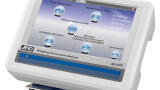
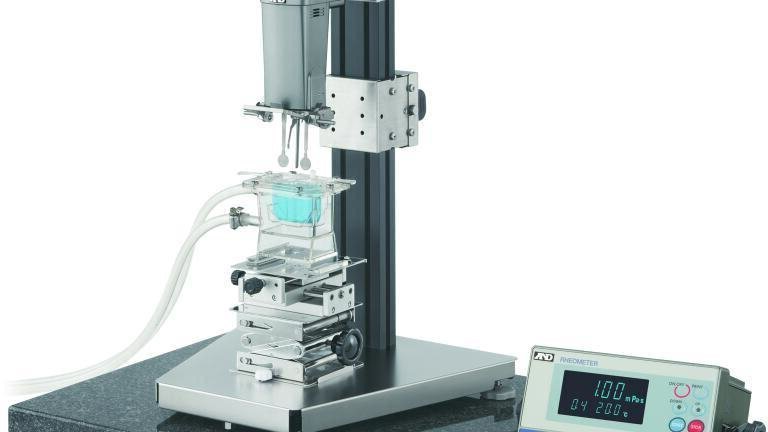
If you are having difficulty in measuring low viscosity samples (e.g. below 100 mPa.s) with precision, you will be interested in A&D’s tuning fork vibro rheometer, the RV-10000.
With its sensor sensitivity heightened through the sharp resonance phenomena of a tuning fork, the RV-10000 can detect viscosities from as low as 0.3 mPa.s and then measure continuously to a maximum of 25,000 mPa.s. It also achieves repeatability as high as 1% of the display value (by standard deviation) for its entire measurement range. This will save you from the frustration of getting a different value each time for the same sample, especially in a low viscosity range.
The RV-10000 has a temperature sensor located next to its viscosity sensor. Further, it is possible to manipulate the shear rate by altering the vibration amplitude of the viscosity sensor. You can therefore easily measure and compare the viscosity changes of non-Newtonian fluids, such as paints, creams, greases and polymers, in response to both temperature and shear rate changes.
Compared with conventional methods, you can set the sample, start measurement, and get the value in a much shorter time (the RV-10000 requires only 20 seconds to stabilise). Cleaning after measurement is also very easy.
ILM 51.6 Sept 2026



 Product directory