.jpg)
-(2).jpg)
Laboratory products
Traceable measurements link a result to certified reference values and, ultimately, to the International System of Units (SI). This means that both the instrument calibration and the reference material used to verify instrument performance must be traceable.
ISO 17025-accredited calibration ensures that an instrument has been calibrated using traceable procedures, standards, and appropriate uncertainty evaluations.
ISO 17025 addresses the competence of testing and calibration laboratories, while ISO 17034 defines the requirements for reference material producers.
Certified reference materials (CRMs) produced according to ISO 17034 must demonstrate traceability, homogeneity, stability, and ongoing quality assurance. This provides an additional level of confidence compared to materials supplied with a simple calibration certificate.
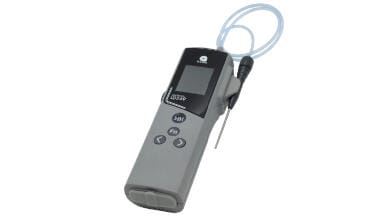
For laboratories seeking the highest level of confidence in their measurement results, Anton Paar offers both ISO 17025-accredited instrument calibration and ISO 17034-certified liquid density reference materials, supporting traceable documentation throughout the instrument lifecycle.
A key consideration for the production of CRMs is the method used to determine the measurement value itself. Hydrostatic weighing is the primary method for determining density.
For ISO 17034 reference material production, Anton Paar has developed its own hydrostatic weighing apparatus, building on decades of expertise in density and temperature measurement. The system enables density standards to be characterised with expanded uncertainties as low as 0.015 kg/m³ while maintaining direct traceability to the primary method and therefore SI units.
This allows certified reference materials to achieve a level of accuracy comparable to those achieved by national metrology institutes. For laboratories, it provides confidence that instrument verification is based on reference values established through one of the most accurate density determination methods available.
A certified value is only meaningful if it remains valid throughout the material's intended lifetime. This is a key requirement for ISO 17034 accreditation.
Unlike reference standards that are certified once and assumed to remain stable, Anton Paar's ISO 17034-certified density standards are continuously monitored throughout their shelf life of 18 months.
Selecting a reference material that matches the density range and characteristics of the samples being measured is best practice.
To support a broad range of applications, Anton Paar offers five ISO 17034-certified density standards covering density values from 750 kg/m³ to 1250 kg/m³ for organic, water-based, and viscous liquids.
ISO 17034 reference materials ensure that density measurements remain accurate, comparable, and traceable over time. Together with ISO 17025-accredited instrument calibration, they provide confidence for your density measurement results.
ILM 51.6 Sept 2026



 Product directory


















.jpg)
.jpg)
.jpg)

.jpg)
