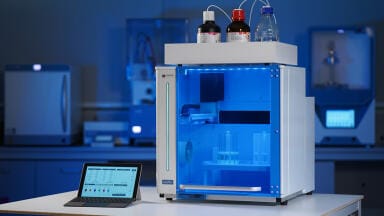
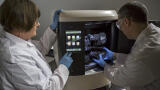
Genevac has announced a new innovation in solvent evaporation technology that enables scientists to pool and productively concentrate large volume sample fractions directly into a single standard sample vial.
For high-throughput applications including compound storage, drug development and environmental analysis, methods that can reduce analytical work are desirable. Pooling of fractions that contain a common analyte, to yield a single sample, save time and are therefore highly desirable. Until now though no commercial technology existed for pooling and concentrating large volume fractions.
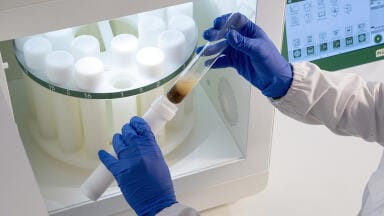
Available in 3 sizes (50ml, 125 ml and 300ml) the ingenious patented design of SampleGenie? enables Genevac's popular EZ-2 and HT series centrifugal evaporators to accelerate the pooling of multiple large volume fractions into a single small sample vial. Constructed in a choice of glass or 316L stainless steel a SampleGenie® is available to cope with most solvent types.
Using SampleGenie? a HT-4X evaporator was able to dry 24 samples in parallel, each containing 50 ml of water in less than 9 hours. Used in conjunction with Genevac's LyoSpeed? methods 24 samples each containing 25ml of water / acetonitrile (60:40) were fast lyophilised in only 6 hours 45 minutes.



 Product directory