Laboratory products
Published over 16 years ago. See the latest and most current information on Laboratory products.
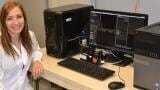
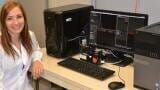
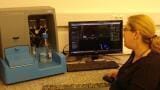
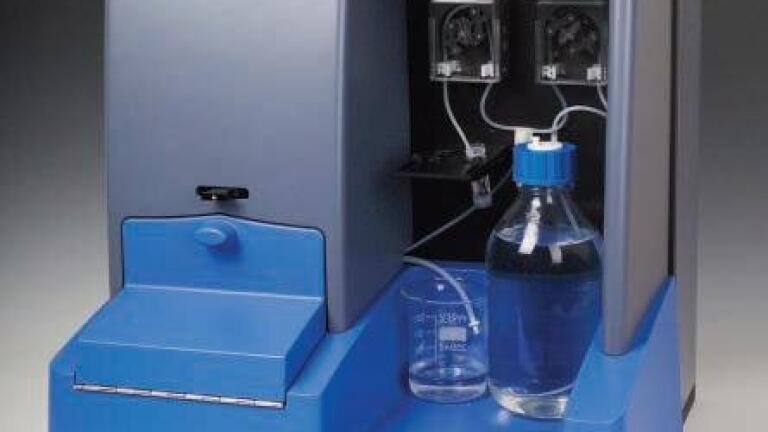
NanoSight announced the release of the NS500 system. The NS500 incorporates new hardware and software to deliver NanoSight’s growing capability in particle-by-particle characterisation, in an automated package. The first system is in use at the University of Oxford in the Nuffield Department of Obstetrics and Gynaecology of the John Radcliffe Hospital as part of a programme supported by the Wellcome Foundation.
NanoSight’s technology, known as Nanoparticle Tracking Analysis (NTA), provides a high-resolution particle size distribution, and not by DLS (dynamic light scattering). NTA detects individual; particles as small as 20nm and, in real time, simultaneously tracks and sizes whole populations. The result is a particle size distribution that provides researchers with the over view of their samples showing everything in the whole range 20 - 1,000nm. NTA also provides count and concentration, together with a unique view that validates these results.
The NS500 adds fluorescence capability, enabling the user to tune into individual particles, with sensitivity to detect individual quantum dots whilst eliminating background interference of other particles and media. Standard beads may be used to bind to single particles for optimum study.
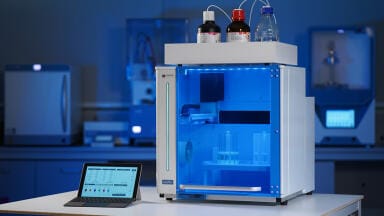
The fluid handling capability of NS500 provides the user with auto sample presentation, optimal dilution and in-situ cleaning. It is now a routine process to clean the cell with the ability to purge, flush and load samples through usercustomisable software. Dilution may also be controlled in this way. Ease of use is enhanced with an autofocus function for readily homing in on the particles in the laser beam. This is combined with two software-controlled motorised stages to ease use, a direct response to user market research. The temperature control of the cell offers a broader range (15°C to 55°C) arriving at the set point rapidly for faster sample
measurement and turnaround time.
ILM 51.6 Sept 2026


 Product directory