Laboratory products
Published over 17 years ago. See the latest and most current information on Laboratory products.
Paraytec has announced the availability of a new eight-page brochure that provides an informative introduction to the multi-award winning ActiPix® D100 miniature UV area imaging detector.
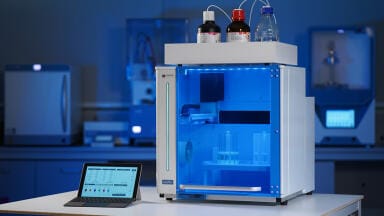
The ActiPix D100 is the world’s first quantitative UV area imaging system. Since its launch, the patented ActiPix technology has been gaining rapid acceptance in a variety of R&D laboratories including proteomics, biocatalysis, biopharma, protein characterisation and formulation optimisation. Its open architecture design makes it ideal as an add-on to many OEM systems.
The miniature detector contains a high-resolution 1280x1024 Active Pixel sensor. The entire or selected areas of the imager can be used to enable research scientists to perform current applications with greater flexibility and performance or to develop applications never before possible, for example, to visualise surface tablet dissolution by UV detection. Examples of applications possible with this powerful and versatile detector include: real time study of diffusion processes, in-line quantification and sizing of biopharmaceuticals, dissolution/solubility testing and membrane transport studies, high sensitivity UV detection for single and multiplexed CE and nanoLC.
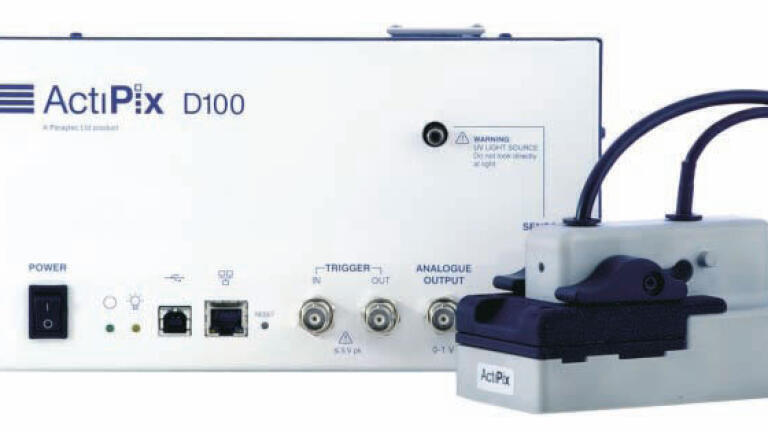
Compact in design, the ActiPix D100 consists of a control box connected via a fibre optic cable and communications cable to a remote sensor head. The sensor head holds easily exchangeable, application-specific cartridges. The cartridges are used in conjunction with powerful software, enabling the end-user to easily switch between applications. The detector can be used as a ’plug and play’ accessory linked in-line to single or multiple peripheral devices, such as syringe pumps, existing CE or nanoLC instrumentation. These can be further coupled to there devices such as mass spectrometers giving a greater depth of information. Detection is performed at a selected wavelength by means of interchangeable filters. The detector wavelength range is 190 to 1100 nm.
(http://www.paraytec.com/downloads/brochures/)
ILM 51.6 Sept 2026




 Product directory