Laboratory products
Published over 5 years ago. See the latest and most current information on Laboratory products.
The quality and effectiveness of drugs depends significantly on their proper packaging: Sterile products and moisture/oxygen sensitive drugs require excellent barrier during the shelf life of the product (up to a couple of years) to protect them from biological contamination, water and oxygen ingress. Otherwise, serious consequences might occur. The high risk in regard to pharmaceutical Container Closure Integrity Testing (CCIT) leads to a strictly regulated environment. Key authorities are the FDA (United States) and the EMA (Europe). What the official regulations often do not describe in detail is how the CCI testing should be performed. They typically only stipulate to use appropriate methods and procedures. The United States Pharmacopeia, the government body in-charge of standards and guidelines for the pharmaceutical industry – which typically are internationally accepted – dealt with this issue and in 2016 presented a new guideline: the USP <1207>. This guideline focuses on sterile and critical pharmaceutical products (e. g. vials and syringes).
Historically, probabilistic test methods like blue dye or microbiological ingress testing have been mainly used in the industry. Nowadays, those methods are being replaced by deterministic methods which reduce the need for sample preparation and validation, and gives more reliable detection of leaks and defects.
The different packaging has to be tested in their early stages of development to a very low leak specification. Moreover, during production a visual inspection and an additional leak test is required up to 100 %, depending on the packaging type. The Limit of Detection (LOD) for production units is defined as a risk-based decision between cost, technology and product. Additionally, laboratory tests and in process controls (IPC) are performed on a tighter sensitivity level.
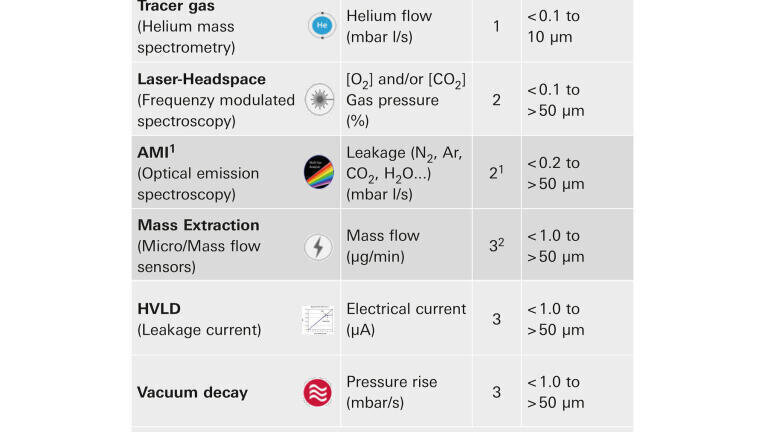
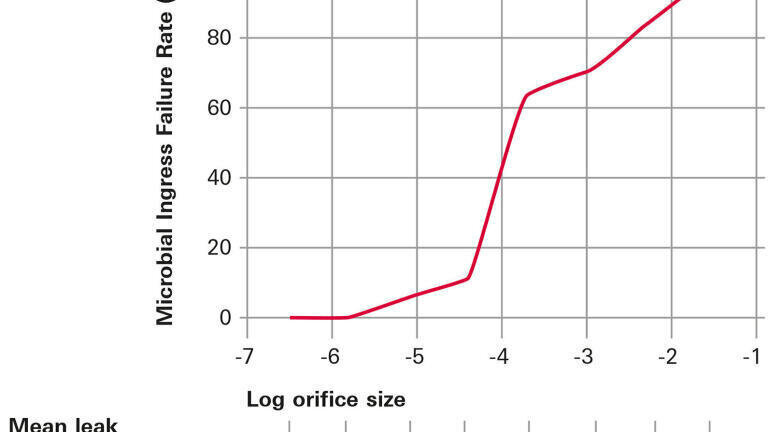
While in the early development stage of packaging, the supplier is obliged to ensure that the packaging is by design capable of ensuring sterility. Therefore, the packaging must to be tested for defects in the range of 0.2 µm, respectively 6 * 10-6 mbar*l/s ("maximum allowable leak level"; MALL). Based on a study from Kirsh, this is the defect size where the microbial ingress failure rate is 0 %. Integrity tests are mainly performed in the range of 2 to 20 µm defect size. The main reason for this is the feasibility of the available methods to detect smaller defects in a reasonable test time. When dealing with 100 % inspection of the production line that operates at speeds for 120 to 600 parts per minute, the allowed defect size is sometimes even increased to a significantly higher level. To compensate on the risk-based approach, additional off-line sample testing is performed to a tighter specification in the range of 1 to 10 µm. This also applies to stability testing which is performed in laboratory tests. Here again the sensitivity is more important than the test time.
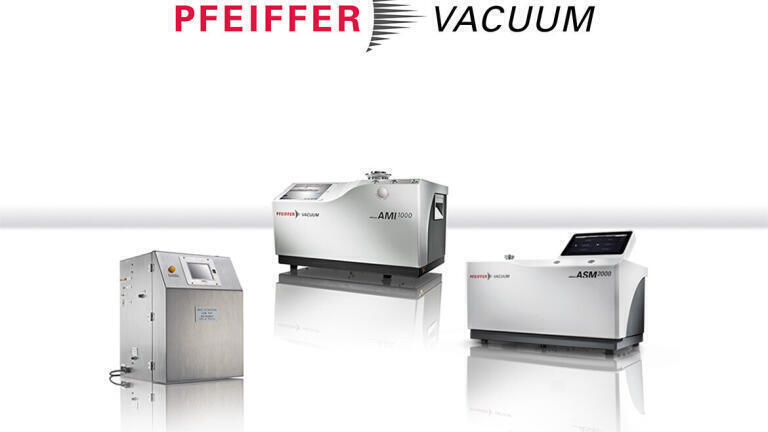
As there is no one-size fits all solution, Pfeiffer Vacuum offers a unique portfolio of equipment dedicated to the pharmaceutical industry.
ILM 51.6 Sept 2026



 Product directory


.jpg)
.jpg)










.jpg)
.jpg)
.jpg)