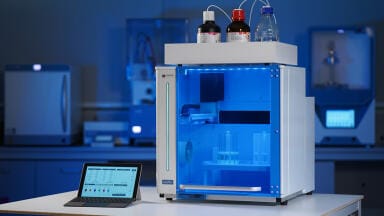
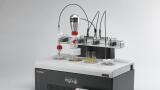
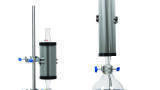
Used with a suitable circulator the new Storm™ Workstation from Radleys provides precise controlled heating and cooling from -65 to +200ºC. Ideal for chemists looking to undertake single or parallel steady state stirred reactions over a wide temperature range.
When combined with the popular Carousel 6 Reaction Station and Tornado
Overhead Stirrer the Storm creates a powerful parallel process reactor that heats and cools, mechanically stirrers up to 6 round bottom flasks under an inert atmosphere, with built-in refluxing, making it the ideal process optimisation and development tool. The Tornado`s powerful mechanical stirring also allows stirring of viscous samples or delicate solids.
Storm was designed using sophisticated modelling software - setting a new standard in precise temperature controlled reaction chemistry. Offering a wide range of operation (-65 to +200ºC), excellent temperature stability (+/- 1ºC) and facility for stirring up to 6 reactions (50 - 250 ml) simultaneously, Storm is the ideal tool for performing steady state reactions such as parallel syntheses.
Storm can also be used with the full range of Radleys` Heat-On Blocks from 10ml to 5 litres to perform individual heated/cooled reactions in a round bottom flask.




 Product directory