Laboratory products
Published over 16 years ago. See the latest and most current information on Laboratory products.
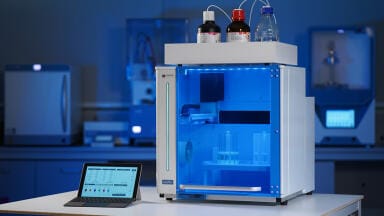
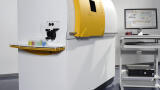
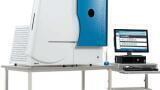
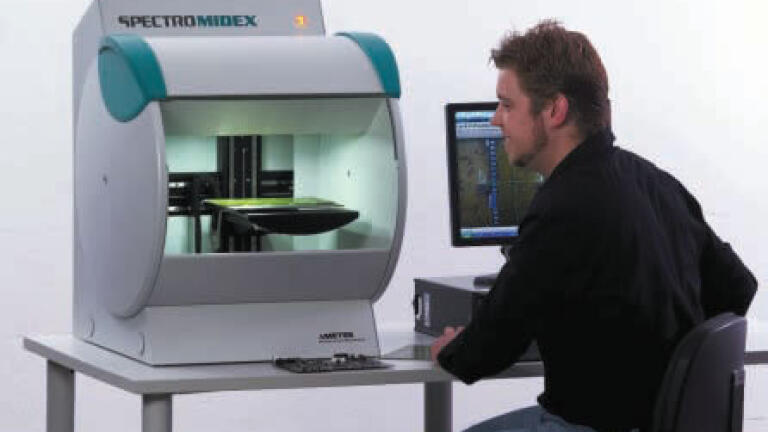
The Spectro MIDEX is a highly sensitive XRF spectrometer specially developed for the analysis of tiny details in samples and for the elemental mapping of larger objects. Typical applications are the identification of toxic elements in electronic devices (RoHS), identification of inclusions, analysis of jewellery and forensic analysis.
The secret of the Spectro MIDEX is the small X-ray beam used to irradiate the sample, which can be collimated down to a minimum spot size of only 200μm. This is combined with a state-of-the-art Silicon Drift Detector (SDD) and a measuring system more than twice as fast as conventional technology. Proprietary ‘FP+’ calibration software permits accurate standardless analysis, even of unknown samples. A complete analysis for elements from magnesium to uranium can be carried out in the range on a given point on an unknown sample in less than a few minutes.
For sample scanning and mapping the generously proportioned sample chamber can be fitted with a precision sample stage that can traverse large samples over a maximum distance of 240x178x160mm in the X,Y and Z axes respectively. The stage can handle samples up to 3kg in weight. An integrated video system combined with a laser spot marker allows precise sample positioning. The standard working distance from the sample is 2mm, but the LD (long distance) version of the Spectro MIDEX has a 20mm working distance from the sample, which is very useful for the examination of irregularly shaped samples - such as analysing the “valleys” between components on a printed circuit board. Software controlled, the XYZ sample stage can also be used as a sample changer for the analysis of large numbers of small samples. The measurement area can be flushed with Helium to achieve maximum sensitivity for the ‘light’ elements from Mg to Cl. This is less likely to damage or otherwise influence samples than a vacuum system, and also means that “damp” samples may be analysed without drying. Helium consumption is less than 100 litres per hour.
ILM 51.6 Sept 2026



 Product directory