Laboratory products
Published over 11 years ago. See the latest and most current information on Laboratory products.
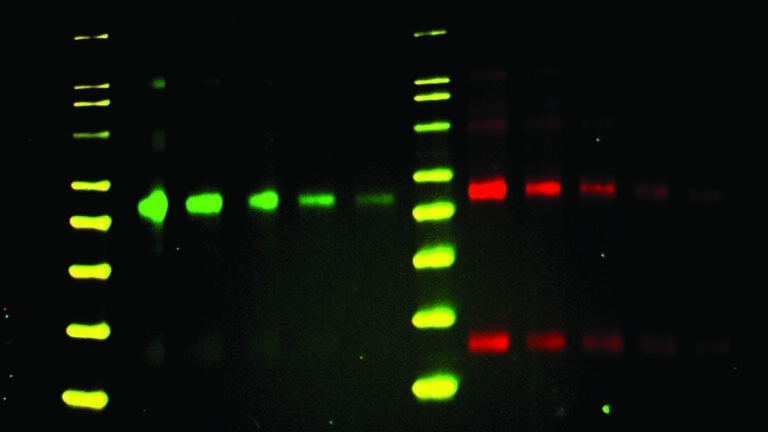
Fluorescent western blotting employs secondary antibodies labelled with a fluorophore to perform direct, non-enzymatic detection of protein expression. Western blotting is commonly used for identification and quantification of specific proteins in a biological sample. Traditionally, a target protein is interrogated by antigen-specific antibodies which are then probed by secondary antibodies conjugated to either HRP or ALP and followed by colorimetric or chemiluminescent detection.
Near infrared (NIR) excitation is possible with UVP LLC’s BioSpectrum® Imaging System with BioLite™ Xe MultiSpectral Light Source which excites a wide spectrum of samples in ultraviolet, visible and NIR ranges. Design flexibility permits use of filter sets to meet specific wavelength requirements and a wide range of fluorescent tags such as Cy3® and Cy5® in the 630 and 770 to 800nm range.
The BioSpectrum® Imaging System with BioLite™ Xe MultiSpectral Light Source (with high intensity Xenon light) allows for detection and image capture of multiple proteins such as in an immunoblot incubated with two different primary antibodies from different species and then probed with CyDye™-tagged secondary antibodies. Fluorescent blotting provides excellent signal stability as well as accurate quantitative analysis with broader dynamic range and high linearity, reducing or eliminating the need to strip and re-probe. Once the images were captured, pseudocolour green and red tools were applied to indicate Cy3 and Cy5, respectively. The images were merged to create a multiplexed image.
The combination of BioSpectrum with BioLite provides a full range of wavelengths for excitation as well as rapid high resolution image capture through the use of deeply cooled cameras and low light lenses. The fluorescent imaging capabilities with applications spanning from NIR to ultraviolet range enables researchers to detect a wide range of fluorescent tagged samples and capture publication-ready images.
Learn More: uvp.com/labspectrum
ILM 51.6 Sept 2026




 Product directory




















.jpg)