Mass spectrometry & spectroscopy
Published over 10 years ago. See the latest and most current information on Mass spectrometry & spectroscopy.
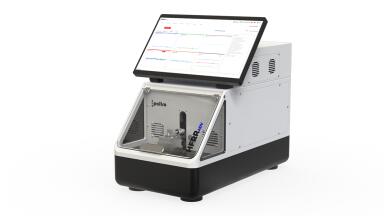
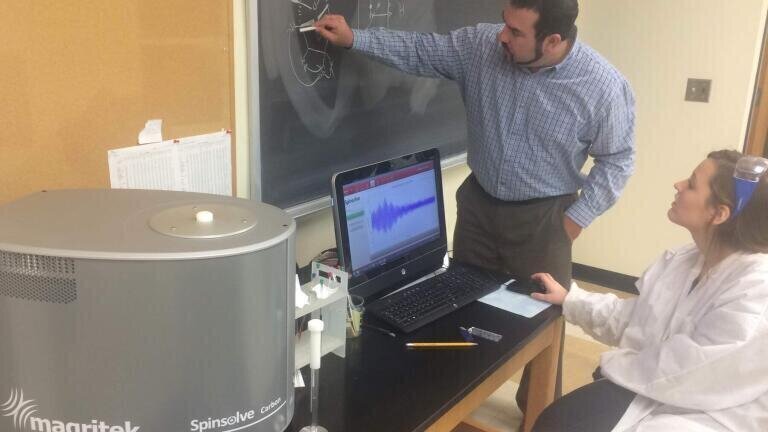
Magritek report on the use of their Spinsolve Benchtop NMR spectrometer in the Chemistry Department of Samford University. It is being applied in research in the areas of organic synthesis, reaction methodology and medicinal chemistry.
Dr Paul Wiget is an assistant professor of chemistry at Samford University in Birmingham, Alabama. He first became interested in the Spinsolve instrument when he began interviewing for his current position knowing that his research interests would require a work-around for the lack of a local high-field NMR. Spinsolve, as a two-channel system with indirect-detection, was potentially the answer. The ability to perform 13C, DEPT, HSQC, HMBC experiments was most important. Dr Wiget also saw the scripting function as extraordinarily helpful as it would enable the running of a HSQC experiment and followed by an HMBC routine allowing extraction from the 13C data overnight even when measuring dilute samples.
Dr Wiget describes his array of experiments used in both research and teaching. “We use NMR in our second semester organic laboratory as means to adequately characterise the intermediate and product of a two-step synthesis, an independent project that makes up about two thirds of the students' grade. We have found that often the carbon channel is most useful in this project due to the inherently low dispersion associated with the proton channel; this is in conjunction with IR, GC-MS, UV-Vis, and melting-point analysis. We also have fluorescence and ICP atomic absorption available.
“We also use the reaction monitoring function to obtain kinetic data for our physical chemistry course. This is particularly useful because the experiment we monitor is the esterification of triflouroacetic acid with various alcohols. With the simultaneous 19F and 1H ‘nested’ monitoring scripts, we can get reinforcing data by monitoring the reaction progress via two nuclei instead of just one. Additionally, when the dispersion issue arises during that experiment, we no longer have to abandon the more substituted alcohols because we can simply monitor the reaction via the 19F spectra.”
Continuing to describe the benefits of Spinsolve, Dr Wiget said: “the greatest benefit of the system is its ease of use and low-level of training for student operation. We are also very fond of no longer needing an air source for spinning. The instrument is very fast and reliable compared to the old, larger, 60 MHz instrument we had.“
ILM 51.6 Sept 2026





 Product directory