Mills and grinders
Published over 11 years ago. See the latest and most current information on Mills and grinders.
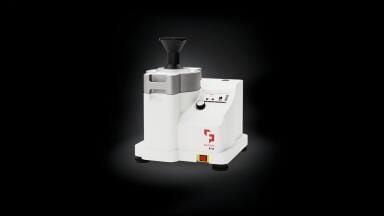
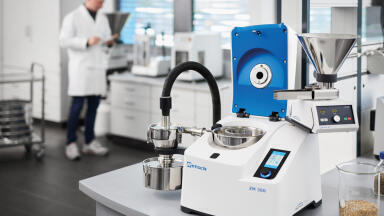
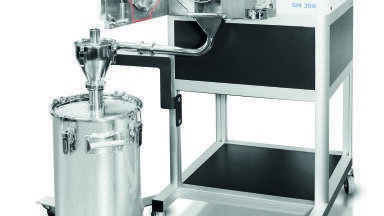
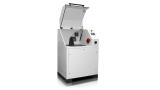
The new generation of Retsch rotor mills SR 300 and SK 300 has been greatly improved with regard to performance, handling and flexibility.
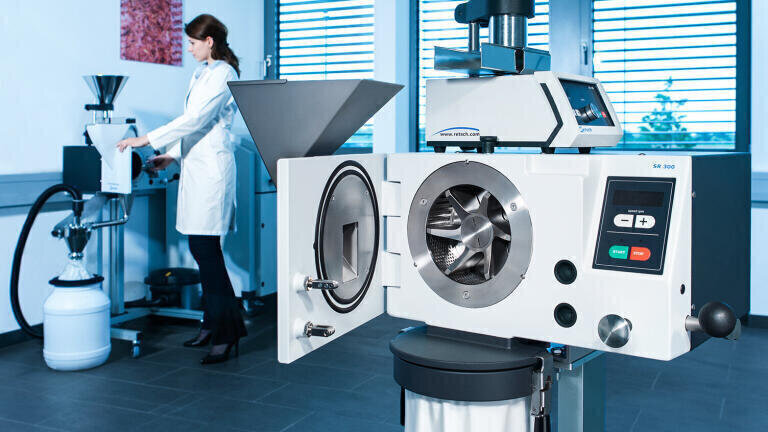
The speed of the rotor beater mill SR 300 has been substantially increased and can be set between 3,000 and 10,000 rpm, thus allowing for optimum adaptation to application requirements. Further new features are the removable cassette and push-fit rotor which can be easily taken out for cleaning without using tools, just like the removable hopper. The cassette allows for almost 100% sample recovery. Grinding chamber, feed hopper and material inlet and outlet of the SR 300 are made from high-quality stainless steel. It is therefore ideally suited for use in pharmaceutical and food laboratories.
The new cross beater mill SK 300 now also operates with higher speed which can be set from 2,000 to 4,000 rpm. Grinding insert and rotor are as easily removable as in the SR 300. Both mills can be equipped with an optional cyclone which improves material discharge, particularly for very fine particle sizes, and provides additional cooling of the sample.
Thanks to their robust design Retsch rotor mills are suitable for applications in the laboratory as well as for small scale production.
ILM 51.6 Sept 2026





 Product directory