News
Published over 12 years ago. See the latest and most current information on News.
What happens when you assemble one thousand tiny identical robots and give them a single command? Does chaos ensue? Or is it possible that they could work together to achieve a common goal?
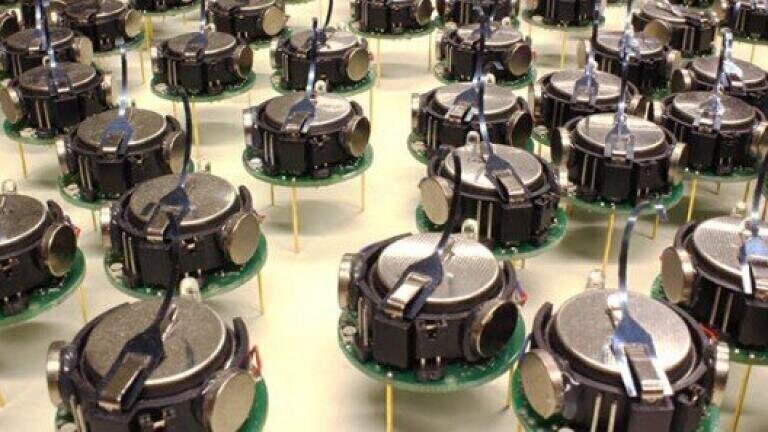
For a team of scientists in the US, it was a question they intended on answering. In the first study of its scale, the Harvard-based Self Organising Systems Research Group set about building a swarm of cylindrical robots - each with a diameter of just 3cm. Known as ‘kilobots’, they all run the same computer program, so that no robot is more ‘intelligent’ than another. The objective of the study? To see if they could form a massive structure to overcome their limitations as an individual.
So why is this idea of teamwork so fascinating? Nature is littered with incredible examples - perhaps most notably in the human body where single cells form together to create an organ with its own specific function. And then there’s the amazing work of ants, who collectively form a ‘lifeboat’ to take the Queen to safety across the water. Despite such prevalence in nature, it has always been difficult for scientists to simulate type of behaviour artificially.
But while it may take up to 12 hours, US scientists have been able to replicate this type of teamwork with their robots. Although separate entities, the robots were able to communicate and form a shape of the scientist’s choosing - slowly shuffling into place until the right form was created.
To begin, the robots are gathered tightly together on a wooden table with sides, to ensure they do not fall off. An infrared light then communicates with the robots via a sensor, giving one singular command: GO! Each robot then kicks into action to form a specific shape, shuffling on their three, stick-like legs based on the actions of their neighbours.
Placed in position by the researchers, four ‘seed’ robots form an outline of the shape required. These are the robots that start coordinating the movement. Each robot can ‘hear’ others within 10cm; compensating for their own erroneous nature by communicating. Using a ‘self-assembly algorithm’, they edge-follow into the desired shape.
The experiment has impressed scientists across the world - not only for its achievements but its affordability too. Scientists in the UK even have them on order, enabling their own experiments of swarm engineering.
Perhaps most excitingly, this idea of collaboration without human control - known as the ‘hive mind’ - is hailing a new era of artificial intelligence. In future, scientists hope that small robots will not only swarm to form arbitrary shapes, but fully-functioning complex machines. ‘Groundbreaking’ would be an understatement.
A new initiative, IGGI, designed to train tomorrow’s engineers and scientists, was recently announced by Universities and Science Minister David Willetts. IGGI postgraduate students will harness the potential of digital games to capture information about human behaviour on an unprecedented scale, providing powerful new scientific tools. They will investigate new research questions arising from the massive growth of digital games, in areas such as Artificial Intelligence. You can read more in this article: Training Leaders in Games Development and Design.
Robotics is increasingly becoming a common place part of our day to lives. For example, researchers in the US have developed a snake-like robot which could perform surgery on the heart or excise prostate tumours.
ILM 51.6 Sept 2026





 Product directory


.jpg)