News
Published over 11 years ago. See the latest and most current information on News.
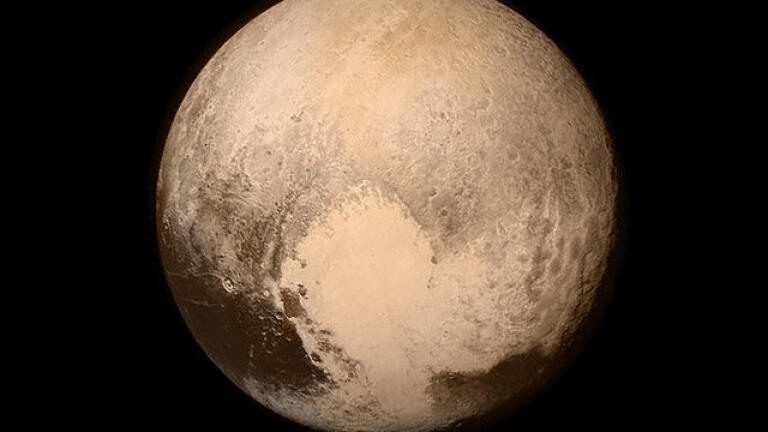
At a colossal 39.5 astronomical units from the sun, Pluto is almost 40 times farther away than Earth. Its elliptical orbit means it generally sits around 3,670,050,000 miles from the sun which means that for space scientists, it’s pretty hard to get to! Up until recently the dwarf planet has remained relatively mysterious, that is until NASA launched its New Horizons mission. It saw the agency send a next generation space craft on a historic flight through the Pluto system in a bid to capture HD images of the enigmatic planet. To get there the craft travelled for over nine years and racked up a total distance of over three billion miles. Talk about finally reaching the end of the road!
The data has just been transmitted back to Earth and when combined with colour data, NASA has been able to paint a remarkably accurate picture of its surface! So what does Pluto look like? Read on for a description of four of the most resplendent images captured by the New Horizons space craft.
Today’s cameras feature ultra-sophisticated technology, with models such as the Long Range Reconnaissance Imager capable of capturing incredible detail from eye-wateringly long distances. While they are an invaluable part of space research, cameras are also used by laboratory scientists to examine miniscule matter such as the particle size of powders. ‘Particle Analysis with a CCD Camera’ looks at how Dynamic Image Analysis is used to carry out small scale projects. The article shines the spotlight on the Fritsch GmbH, a functional and economically priced instrument which is ideal for analysing dry, well free-flowing bulk solids.
Images sourced via Flickr Creative Commons. Credits: NASA’s Marshall Space Flight Center
Lab Asia 33.4 - August 2026



 Product directory