News
Published over 11 years ago. See the latest and most current information on News.
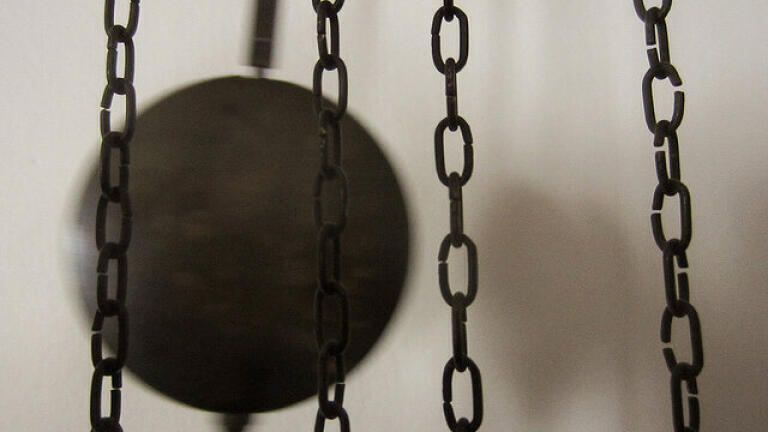
Since Dutch scientist Christiaan Huygens first invented the pendulum clock back in 1656, the world has been captivated by the perfectly synched time keeping devices. At the time of creation the pendulum clock was hailed as the most accurate timepiece on the planet, with an error margin of less than 10 seconds. Time is measured using a pendulum suspended from a wire, rod or string. The speed at which the pendulum swings is determined by its length which should be adjusted to suit the dimensions of the clock.
Huygens noted that when two pendulum clocks are hung side by side their pendulums would eventually swing in unison, yet in opposite directions. The conundrum has spanned for over 350 years and now, a pair of physicists has busted the phenomenon in a write up published in Scientific Reports journal. They claim a sound pulse triggers an energy transfer which then causes the clocks to synchronise.
The revelation was discovered by a pair of Portuguese scientists who assert that these sound pulses jump from clock to clock. As they transfer they disquiet the swing of the pendulums which eventually causes them to harmonise. Regardless of how or when they start, they’ll always swing in unison within 30 minutes! To put forward the watertight hypothesis the scientists developed a bespoke complex mathematical model. They then fixed two clocks to a wall and started to observe. Both the theoretical predictions and pendulum synchronisation came to light.
Co-author Luis Melo of Lisbon University’s physics department explains, “We could verify that the energy transfer is through a sound pulse.” He maintains that as well as solving “an old, fundamental problem,” the discovery also enhances the scientific world’s understanding of other oscillator types.
As suggested by the latest pendulum clock findings, even the smallest amount of energy can have a big impact. ‘Low Energy, Low Temperature Liquid Source Evaporation’ looks at how industries can convert liquid source into a homogenous vapour using a pre-engineered, low temperature, low energy consumption evaporation system pioneered by Bronkhorst. Named New Vapour Delivery Modules, the systems are ideal for variable flow rates, variable concentration, fast switching and multiple liquid sources. At the core of the technology is Bronkhorst’s tried and tested Controlled Evaporator Mixer (CEM) System. New advancements and integrations have extended the system’s capabilities and made it more energy-efficient than ever before.
Images sourced via Flickr Creative Commons. Credits: kbrookes
Lab Asia 33.4 - August 2026

 Product directory