News
Published over 13 years ago. See the latest and most current information on News.
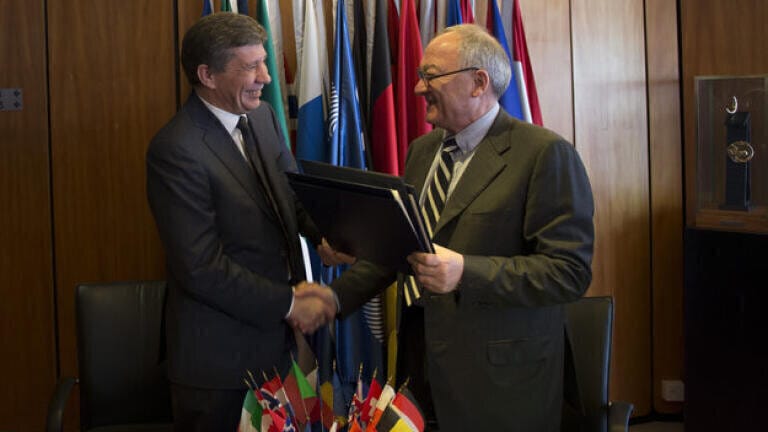
ESA and the Russian federal space agency, Roscosmos, have signed a formal agreement to work in partnership on the ExoMars programme towards the launch of two missions in 2016 and 2018. Establishing whether life ever existed on Mars is one of the outstanding scientific questions of our time and the highest scientific priority of the ExoMars programme.
The partners have agreed a balanced sharing of responsibilities for the different mission elements. ESA will provide the Trace Gas Orbiter (TGO) and the Entry, Descent and Landing Demonstrator Module (EDM) in 2016, and the carrier and rover in 2018. Roscosmos will be responsible for the 2018 descent module and surface platform, and will provide launchers for both missions. Both partners will supply scientific instruments and will cooperate closely in the scientific exploitation of the missions.
The 2016 mission has two major ESA elements: TGO and EDM. TGO will search for evidence of methane and other atmospheric gases that could be signatures of active biological or geological processes. It will also serve as a data relay for the 2018 mission. EDM will land on Mars to prove key technologies for the 2018 mission.
In 2018, the ExoMars rover, to be provided by ESA, will search the planet’s surface for signs of life, past and present. It will be the first Mars rover able to drill to depths of 2 m, collecting samples that have been shielded from the harsh conditions of the surface, where radiation and oxidants can destroy organic materials.
NASA will also deliver important contributions to ExoMars, including the Electra UHF radio package for TGO, and Mars Proximity Link telecom and engineering support to EDM.
ILM 51.6 Sept 2026




 Product directory


.jpg)