News
Published over 11 years ago. See the latest and most current information on News.
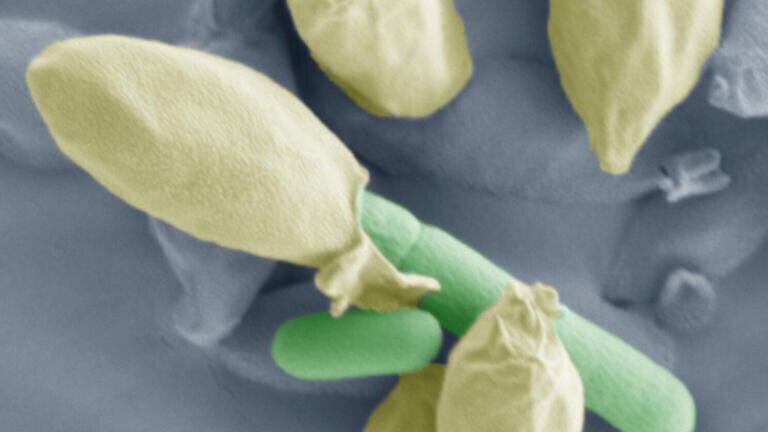
Researchers at the Institute of Food Research (IFR)have established how clostridia bacteria emerge from spores, which can help in the understanding of how these bacteria germinate and go on to produce the deadly toxin responsible for botulism (a lethal form of food poisoning) or cause food spoilage. Having recently1 uncovered the genetic controls of spore germination, scientists have now visualised the structural changes spores undergo during germination.
Dr Jason Brunt working with microscopist Kathryn Cross examined Clostridium sporogenes, a close relative of Clostridium botulinum that although less dangerous, can cause significant food spoilage problems.
Their images showed that the spores have an outer covering, called an exosporium, with an aperture at one end. Closer examination showed that this aperture aligned with a spot on the spore where it ruptures during germination, and that the newly formed cell emerges through these holes. This suggests that the spores have polarity that aligns the structures correctly.
“We think that this polarity is genetically pre-determined in the dormant spore,” said Dr Jason Brunt. “Our long term aim is to formulate detailed strategies to interrupt these processes. This would be of great benefit to the food industry to help control these pathogenic and spoilage clostridia.”
The IFR is strategically funded by the Biotechnology and Biological Sciences Research Council.
Reference*: Apertures in the Clostridium sporogenes spore coat and exosporium align to facilitate emergence of the vegetative cell, Jason Brunt et al, Food Microbiology doi:10.1016/j.fm.2015.04.013
Reference1: Brunt J, Plowman J, Gaskin DJH, Itchner M, Carter AT, et al. (2014) Functional Characterisation of Germinant Receptors in Clostridium botulinum and Clostridium sporogenes Presents Novel Insights into Spore Germination Systems. PLoS Pathog 10(9): e1004382. doi:10.1371/journal.ppat.1004382
Lab Asia 33.4 - August 2026



 Product directory