News
Published over 7 years ago. See the latest and most current information on News.
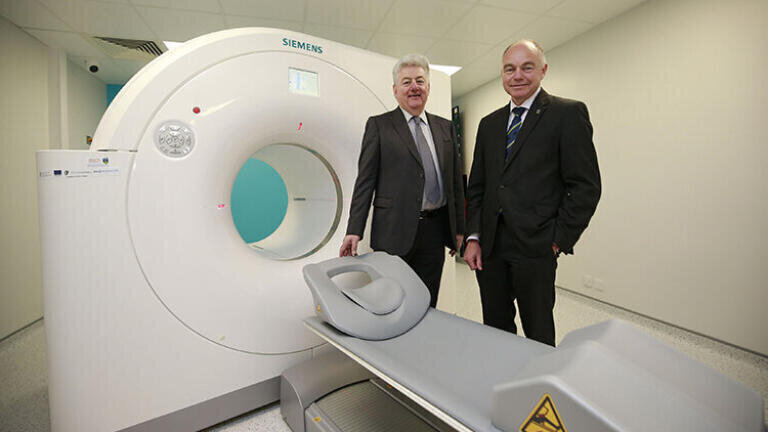
A new PET CT Research Imaging Centre at St Vincents University Hospital and University College Dublin will enable radiologists to access higher quality images as part of their diagnostic investigations. This means earlier detection and more accurate diagnosis of diseases, as well as lower doses of radiation for patients compared to conventional PET CT scanners. The centre has been funded by the Higher Education Authority under PRTLI 5 (Programme for Research in Third Level Institutions) and the Health Services Executive.
“Our new Centre marks an important step forward in the detection and treatment of major diseases,” said James Menton, Chairman of St. Vincent’s Healthcare Group. “Our patients can directly benefit from this highly advanced technology which will not only lead to earlier diagnosis, treatment and improved health outcomes but will also offer the patient greater piece of the mind much earlier in their treatment journey.”
“An important feature of this new Centre is our partnership with UCD and the ability to use the scanner for on-going research, education and clinical trials,” he continued.
“As an academic, research-intensive teaching hospital, this collaboration will mean that we are able to diagnose and treat patients today with the most advanced equipment in the country which is also allowing us to test, investigate and pioneer new treatments for the future,” he added.
Speaking at the recent opening of the new PET CT Research Imaging Centre, Professor Andrew Deeks, President of University College Dublin said: “We believe that this combination of patient therapy and clinical research leads to better outcomes for patients and improved impact in terms of contribution to global research,” he added.
“The availability of this advanced technology opens further interdisciplinary research involving medical scientists, physicists and nano-scientists, molecular biologists and chemists, and biomedical engineers. And the development of this centre provides our investigators with a vital new tool in our efforts to understand health and disease as we together seek new ways to improve outcomes for patients.”
ILM 51.6 Sept 2026





 Product directory