Research news
Researchers have identified a molecular pathway, involving the proteins IRP1 and ARID3A, that allows pancreatic cancer cells to evade a form of cell death called ferroptosis and resist chemotherapy so offering a possible new treatment target
Pancreatic cancer remains one of the most lethal malignancies, and poor survival rates have long been attributed to its cancer cells’ both intrinsic and acquired resistance to chemotherapy. Ferroptosis, an iron-dependent form of regulated cell death, has emerged as a promising route by which to overcome this resistance, yet the molecular mechanisms that allow pancreatic cancer cells to evade it remain incompletely understood.
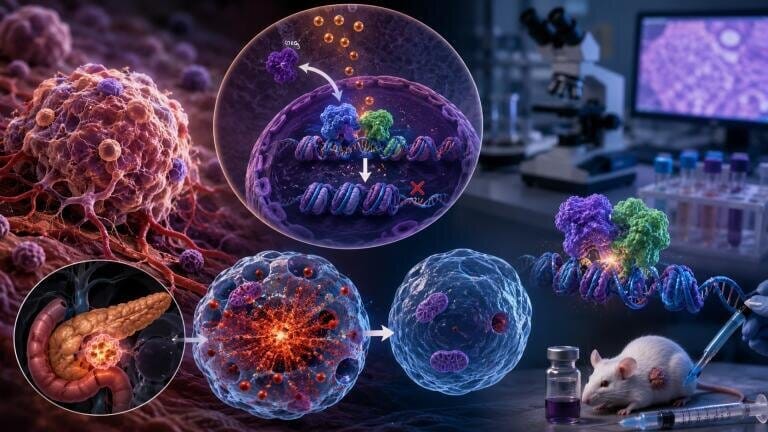
A study by researchers from the Chinese Academy of Medical Sciences and Peking Union Medical College, both in Beijing, China, has identified a previously unrecognised epigenetic mechanism that pancreatic cancer cells use to evade ferroptosis and resist chemotherapy. According to the study, the iron-responsive protein iron regulatory protein 1 (IRP1) cooperates with the transcription factor AT-rich interactive domain-containing protein 3A (ARID3A) to suppress ferroptosis and promote resistance to chemotherapy drugs such as gemcitabine.
The researchers found that both IRP1 and ARID3A are highly expressed in pancreatic cancer tissue and that high levels of either protein correlate strongly with poor responses to chemotherapy leading to worse patient survival outcomes. Functional studies showed that elevated levels of either protein were able significantly to enhance tumour cell proliferation and resistance to gemcitabine, while genetic silencing of IRP1 or ARID3A was able to restore chemosensitivity and suppress tumour growth. Together, these findings establish the IRP1–ARID3A signalling axis as a key determinant of how pancreatic cancer responds to treatment.
Mechanistic work has shown that an accumulation of iron within the cell triggers IRP1 to translocate to the nucleus, where it interacts directly with ARID3A. The resulting IRP1–ARID3A complex then binds to the promoter region of cytoglobin (CYGB), a gene known to protect cells from oxidative stress and regulate ferroptosis. The complex does not repress transcription of the gene directly but instead it was found to remodel chromatin so as to reduce promoter accessibility, which suppressed CYGB expression through an epigenetic route.
The loss of CYGB profoundly altered the cells’ redox balance. Pancreatic cancer cells were shown to exhibit reduced lipid peroxidation and a diminished accumulation of reactive oxygen species, together with an enhanced resistance to ferroptotic cell death, all of which allowed the cells to survive the oxidative stress induced by chemotherapy. When CYGB expression was restored, or the IRP1–ARID3A complex disrupted, these effects were reversed and tumour cells became sensitised to ferroptosis once again, with the efficacy of chemotherapy improving significantly as a result.
The study also demonstrated the therapeutic potential of targeting this pathway in preclinical models. Inhibition of IRP1 or ARID3A, particularly when combined with agents that induce ferroptosis or with conventional chemotherapy, was found markedly to suppress tumour progression and enhance anti-tumour responses. The findings suggest that a strategy to overcome ferroptosis resistance could prove effective in improving outcomes for pancreatic cancer patients who fail to respond to standard treatment.
Taken together, the work identifies the IRP1–ARID3A–CYGB axis as a central regulator of both ferroptosis resistance and chemotherapy failure in pancreatic cancer. By linking iron metabolism, chromatin remodelling and regulated cell death, the study has uncovered a novel therapeutic vulnerability, and it provides a strong rationale for combining epigenetic modulation with ferroptosis-based therapies in the fight against one of the most treatment-resistant of human cancers.
For further reading please visit 10.1016/j.gendis.2025.101866
ILM 51.6 Sept 2026



 Product directory















,-photo-Karin-Allander.jpg)




.jpg)
