Microscopy & microtechniques
Published over 16 years ago. See the latest and most current information on Microscopy & microtechniques.
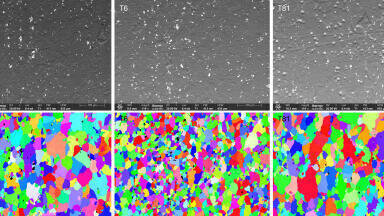
Electron BackScatter Diffraction (EBSD) is a rapidly growing addition to the battery of techniques routinely employed by scanning electron microscope users, producing an electron backscattering pattern (EBSP) that
relates exactly to the crystal structure and orientation of the sample under examination. Although the first EBSP was published by Nishikawa and Kikuchi in 1928, many would correlate its growing popularity with the rise of
the scanning electron microscope (SEM) since its commercial introduction in 1965. By 1967, Coates was describing observation of Pseudo Kikuchi lines in work that led directly to selected area electron channelling patterns (SAECP). In this technique, the electron beam is rocked from side-to-side over a point on a horizontal sample surface and a map of the intensity of backscattered electrons generated. Although the angular resolution of SACP is superior to EBSD, two main drawbacks exist: a fundamentally low resolution of 5 μm and a complex electron optical configuration.
ILM 51.6 Sept 2026





 Product directory














.jpg)