Labmate Awards for Excellence 2025
A different, much simpler way to carry out traditional amino acid analysis (“AAA”)
AAA is used in many complex diagnostic and analytical processes, including:
Clinical Diagnostics:
Identification and analysis of:
Monitoring:
AAA is also widely used in:
Why is what JPP has discovered better than the way traditional AAA has been carried out since the 1950s (the Moore & Stein method)?
All reagents (which are added to samples to cause a chemical reaction to take place) used in AAA across the globe formerly required the use of air-intolerant “hydrindantin” in their composition. Hydrindantin is difficult to handle during manufacture and, before analysis can take place, end users must mix it in complex and laborious ways with other “air-stable” compounds (ninhydrin being the most important) supplied in a separate “bottle”. All AAA instrument and reagents’ manufacturers thus produce a “two-bottle” reagent ‘kit’ which, once mixed, has a very short life.
There has been no other way to carry out (traditional) AAA since Moore & Stein, two Nobel Prize-winning US chemists, discovered their method in the 1950s. It has always been regarded as “the gold standard”.
What is Traditional AAA?
Traditional AAA is carried out on an HPLC instrument using ion exchange separation of amino acids followed by ninhydrin post-column spectrophotometric detection. The cumbersome chemical methodology used in this process has remained unchanged for 70 years. JPP has discovered new ways to achieve better analysis. These have been extensively independently tested and are proven beyond doubt.
What is JPP Chromatography Ltd?
JPP is a UK-based R&D company which, since its incorporation, has focused exclusively on bringing AAA into the 21st century.
Using comprehensive knowledge of analytical chemistry and a deep understanding of separation science, JPP has discovered different, much simpler ways to carry out traditional AAA, without compromising integrity. These all involve the use of ninhydrin reagents that DO NOT contain hydrindantin.
The chemistry underpinning JPP’s novel methodology is explained on its website: http://www.jppchromatography.co.uk/. JPP uses novel chemical and physical processes, so that a totally stable “one bottle” reagent produces hydrindantin when and where it is needed – in the heated post column reaction zone inside the amino acid analyser, whilst analysis is taking place.
JPP has protected its discoveries in 3 core patents in 8 key global territories (24 patents in all). JPP refers to the core patents simply as: Patent 1, Patent 2 & Patent 3.
All JPP’s reagents in its patents are free from hydrindantin. All are stable at room temperature in the presence of air.
(i) Under Patent 1, when heated in the post-column reaction zone hydrindantin is produced that allows analysis to place.
(ii) Patent 2 improves on Patent 1 by introducing a pre-heater – a straightforward and inexpensive modification to the analyser - to accelerate the production of hydrindantin within the instrument, increasing sensitivity to a higher level than is achievable using a Patent 1 reagent on an instrument without a pre-heater.
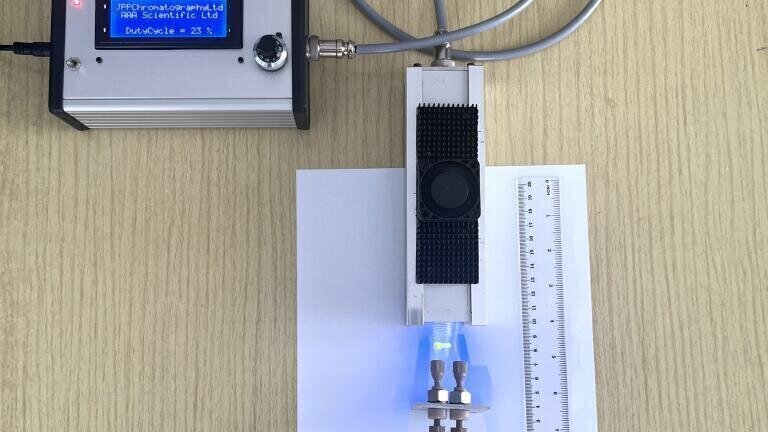
(iii) The technology behind Patent 3 is very different. It is the most innovative of JPP’s discoveries and most deserving of an award for innovation. Under this patent, a reagent comprising only ninhydrin, a solvent and a buffer, is irradiated with UV light to generate a pre-determined concentration of hydrindantin ‘in-line’ at room temperature. A unique photochemical reaction takes place inside the UV light chamber, giving users unprecedented control of hydrindantin concentration immediately before exposure to the heated reaction coil. What is even more novel is that concentrations of hydrindantin in-line are regulated electronically and can therefore instantly be changed to suit eluent flow rates and reaction times of the colour-forming coil. Detection sensitivities thus remain at maximum levels regardless of chromatographic conditions.
Patent 1 is licensed “non-exclusively” to an established AAA company: https://www.youtube.com/watch?v=kzW9EpChpHA
Patents 2 & 3 remain to be licensed, either exclusively or otherwise.
A tiny company (JPP) using the most basic physical resources has solved a problem that has blighted an industry for 70 years. It is disappointing that very well-paid individuals in that industry apparently fear change.
ILM 51.6 Sept 2026



 Product directory






















.jpg)
