Centrifuge
Published over 10 years ago. See the latest and most current information on Centrifuge.
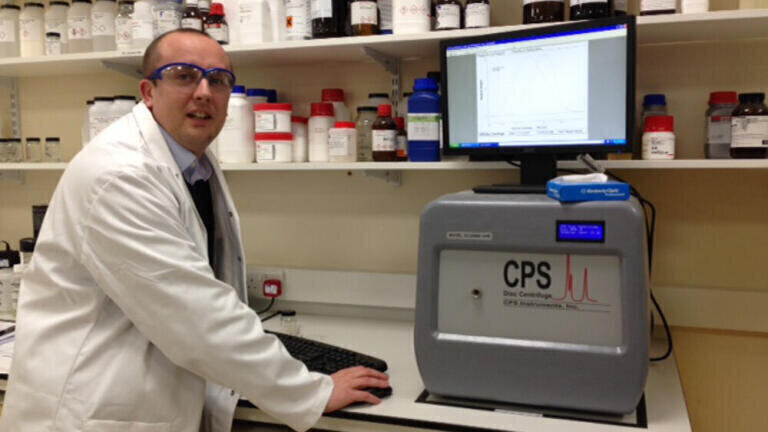
Analytik report on Scott Bader's characterisation of conventional and inverse emulsions using the CPS Disc Centrifuge UHR.
Scott Bader is a multinational chemical company with production and laboratory facilities around the world. The group develops conventional and inverse emulsion products for a variety of industrial applications, as well as providing technical support for production. The most familiar type of emulsion is probably the oil in water emulsion. This is sometimes called a conventional or o/w emulsion. However, it is also possible to form an inverse or water in oil (w/o) emulsion. In an inverse emulsion, the water droplets are dispersed in a continuous phase of oil.
Speaking about the benefits of the CPS Disc Centrifuge UHR, polymer development manager, Luke Alger, said: “Particle size is a very important characteristic of both conventional and inverse emulsions. Prior to the purchase of the CPS Instruments system, it was not possible to measure the particle size of inverse emulsions. Also the group is able to get a lot more detail for conventional emulsions compared to using the other techniques leading to greater control in improving product properties.”
The CPS DC24000 UHR is an effective analytical tool for ultra-high resolution, high accuracy measurement of particle size distribution. Highly poly-dispersed particles can be measured in the size range of ~3.0 nm to ~60 microns, at 2 to 10 times better resolution than any other particle sizing instrument, regardless of measurement technique.
Utilising Differential Centrifugal Sedimentation (DCS), the CPS Disc Centrifuge UHR offers the unique ability to resolve very close multimodal particle distributions and to distinguish extremely small shifts in particle size. Rather than using a predictive algorithm, the instrument physically separates the nanoparticles and then measures them as they pass a light beam - providing full characterisation in real time.
As Product Specialist, Hiran Vegad said: “The CPS Disc Centrifuge provides particle sizing data that always surprises users when compared to data produced with traditional light scattering techniques such as DLS or Laser Diffraction. The CPS technique is easy to understand and use, and by giving real, accurate, reliable and reproducible data, it makes the instrument an integral part of every particle characterisation lab.”
ILM 51.6 Sept 2026




 Product directory














.jpg)