HPLC
Published over 13 years ago. See the latest and most current information on HPLC.
By Christian Gotenfels
Agilent Product Manager for Liquid Chromatography
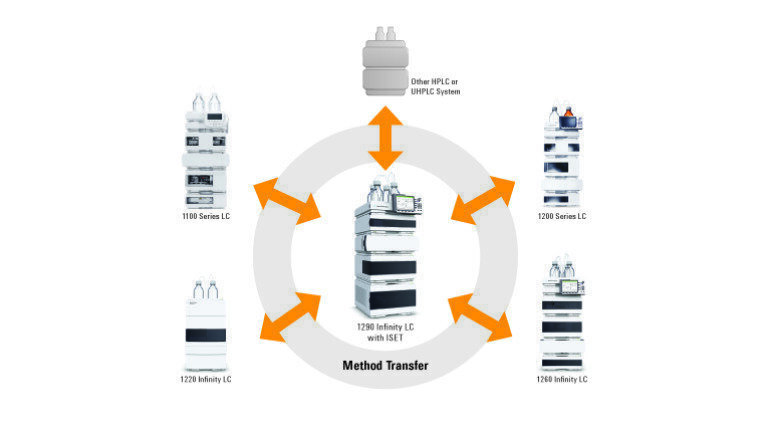
Instrument-to-instrument method transferability is an important topic for all laboratories throughout all industries, where HPLC and UHPLC methods are transferred between different departments and locations with different LC instruments. Especially in highly regulated environments such as quality control in the pharmaceutical industry, the transfer of LC methods is a challenge because any modification of the original method needs to be avoided.
Which parameters affect method transfer?
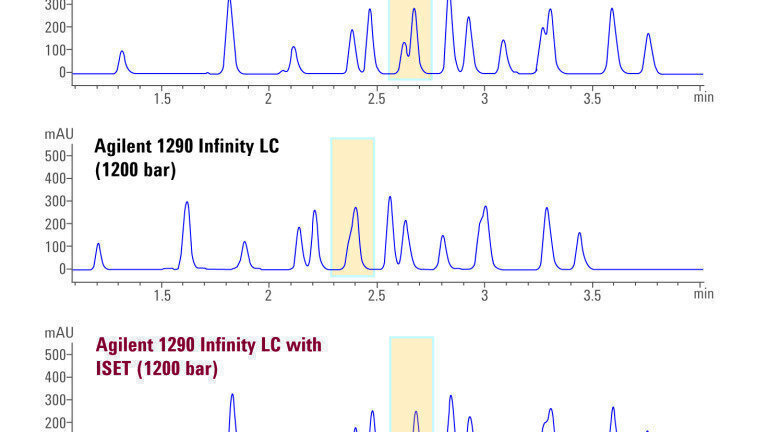
Design differences between LC instrumentation – such as power range, delay volume, mixing behaviour, temperature control, extra column volume and detector cell design – all affect the ability to transfer a method from one system to another. Especially the transfer of methods from older HPLC platforms such as Waters Alliance to the latest UHPLC technology platforms such as the Agilent 1290 Infinity LC could result in different retention times and chromatographic resolution.
The impact of delay volume and gradient mixing
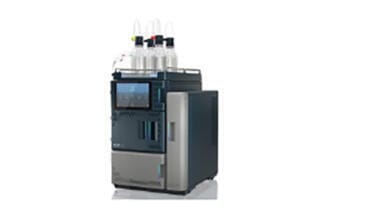
The delay volume of an LC system determines how fast the gradient reaches the column. Further, the mixing behaviour influences the gradient profile. The Waters Alliance 2695 HPLC system is specified with a delay volume of 650 µL and the eluents are mixed together on the low pressure side of the pump. In contrast the delay volume of the high pressure mixing Agilent 1290 Infinity Binary LC system is <140µL. The consequences for method transfer are differences in retention times and in chromatographic resolution.
Agilent 1290 Infinity Binary LC with ISET for infinitely better instrument-to-instrument method transfer
Agilent’s ISET – Intelligent System Emulation Technology – makes the Agilent 1290 Infinity Binary LC the most adaptive UHPLC system available. It can execute any legacy HPLC or latest UHPLC method and deliver the same chromatographic results without the need to change the original method or modify the instrument hardware.
This new technology is based on two Agilent innovations:
Higher productivity and cost savings for both method development and QA/QC
With 1290 Infinity Binary LC and ISET you can speed up your method development with UHPLC performance and then fine-tune your method by emulating the target system – and be confident that the method will run as intended. No more method transfer problems in QA/QC! Simply emulate the LC system on which the original method was developed – with a single mouse click. You can run your legacy methods with ISET and at the same time take full advantage of the UHPLC speed, resolution and sensi tivity of the Agilent 1290 Infinity Binary LC. No need to maintain your old legacy LC systems.
For more information about Agilent’s Intelligent System Emulation Technology (ISET), see www.agilent.com/chem/infinity-iset
ILM 51.6 Sept 2026





 Product directory