Laboratory events news
Research presented by Dr Jimena Perez Sanchez at ELRIG in Cambridge has set out how chemogenetics and related gene therapy strategies may reduce chronic pain by dampening hyperactive peripheral sensory neurons, with early evidence from animal models and human stem cell-derived neurons
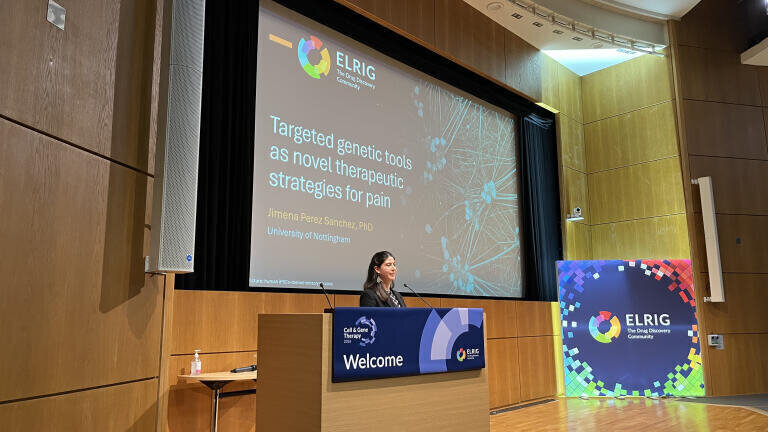
Chronic and intractable pain has remained one of the most difficult areas in medicine to treat effectively, and research presented by Dr Jimena Perez Sanchez, assistant professor in neuroscience at the University of Nottingham, UK, highlighted a possible route towards more precise, non-addictive therapies. Speaking at the ELRIG meeting in March 2026 at the Hinxton Hall Conference Centre on the Wellcome Genome Campus, Perez Sanchez set out a translational strategy to tackle pathological pain by directly altering the excitability of peripheral sensory neurons.
Chronic pain is not a single disease but a broad and heterogeneous group of conditions that may arise after tissue injury, inflammation, nerve damage or other pathological processes. A therapy that works for one form of pain may prove ineffective with another while many existing drugs have limited specificity and can produce unwanted adverse effects. Against that backdrop, the talk argued that a common biological denominator may unite many otherwise distinct pain states and the abnormal hyperexcitability of peripheral sensory neurons.
These neurons form the first stage of the pain pathway. They detect thermal, mechanical and noxious stimuli in the periphery and relay that information to the central nervous system. Under healthy conditions, they fire only when appropriate and in proportion to the stimulus received. In chronic pain states, however, that control can fail. Perez Sanchez described how sensory neurons may then begin to fire too readily, respond too strongly or discharge spontaneously in the absence of any external trigger. That altered electrical behaviour can drive persistent pain and hypersensitivity.
This emphasis on peripheral sensory neurons reframed the therapeutic problem. Rather than suppress pain broadly across the nervous system, her work has sought to intervene at a point where pathological signalling begins. If hyperactive sensory neurons act as a major driver of chronic pain, then strategies that reduce that hyperactivity may offer a direct way to relieve symptoms while avoiding some limitations of less selective approaches.
Perez Sanchez explained why conventional pharmacology has often fallen short. A wide range of membrane receptors and ion channels have been implicated in pain signalling, yet such proteins are often expressed across multiple tissues and cell types which makes selective intervention difficult. Her presentation therefore moved away from correcting single molecular defects and instead towards a broader means to regulate neuronal output itself.
The first of the two main strategies presented was chemogenetics. In simple terms, this approach involves expression of engineered ion channels or receptors in a defined population of neurons, followed by use of a selective ligand to control those cells on demand. In this case, the goal was to silence pain circuits. Perez Sanchez described a system based on a modified human ligand-gated ion channel framework redesigned so that it no longer responded to its natural ligand but instead could be opened by an external small molecule.
Her group first tested this approach in dissociated neuronal cultures. The constructs included a fluorescent reporter so expression could be confirmed directly, while electrophysiology provided the functional readout. The results showed that neurons carrying the chemogenetic actuator became less excitable after exposure to the selected ligand, with increases in rheobase and other changes consistent with reduced membrane excitability.
The work then moved into in vivo models through viral delivery, particularly with adeno-associated virus serotype 9, which appeared to produce robust expression in dorsal root ganglion neurons. In preclinical pain models, activation of the engineered channel appeared to increase mechanical withdrawal thresholds and reduce responses to noxious stimulation. In inflammatory and neuropathic pain models, the same principle reversed established hypersensitivity.
Perez Sanchez also referred to changes in spontaneous behaviours such as burrowing and digging, which tend to decline when animals are in pain. Restoration of such behaviours after chemogenetic silencing strengthened the interpretation that the intervention had relieved an aversive pain state.
A compelling part of the presentation came when the work moved beyond rodent systems and into human biology. Perez Sanchez reported experiments in human induced pluripotent stem cell-derived sensory neurons which provided a means to test whether the same chemogenetic strategy could attenuate firing in human pain-relevant cells – and it could. The work then went a step further by examining patient-specific induced pluripotent stem cell-derived sensory neurons from people with inherited pain disorders. In those patient-derived neurons, the same chemogenetic system reduced aberrant firing activity.
Perez Sanchez said successful gene therapy approaches require an effective active component and delivery system and added that her group had used chemogenetic strategies to silence sensory neurons and reduce behavioural hypersensitivity in inflammatory and neuropathic pain models.
Her second major strategy described shifted from engineered silencing to enhancement of an endogenous inhibitory mechanism. Here, Perez Sanchez focused on KCNQ2 – a potassium channel subunit associated with the M-current – which helps stabilise membrane potential and restrain excessive firing. Her group had explored adeno-associated virus-mediated overexpression of KCNQ2 in sensory neurons. The electrophysiological data presented indicated that this approach reduced firing and made neurons less excitable.
As her talk concluded, Perez Sanchez addressed one of the principal practical barriers to translation which is vector performance. Although adeno-associated virus serotype 9 had proved useful, she noted that it still carried limitations, including the time required to achieve strong expression. She described collaborative efforts to identify alternative naturally occurring viral capsids with stronger neuronal tropism and faster onset.
Overall, the presentation offered a coherent case that chronic pain may be amenable to gene therapy strategies that reduce peripheral sensory neuron hyperexcitability. Taken together, the findings suggest that fully humanised chemogenetic systems, alongside complementary approaches such as KCNQ2 enhancement, may help to lay the groundwork for a more precise class of pain therapies capable of suppressing pathological signalling at its source without reliance on addictive drugs.
ILM 51.6 Sept 2026



 Product directory
















.jpg)

.jpg)










.jpg)
