Laboratory events news
Ikarovec has presented preclinical evidence for IKAR-001, a dual-pathway gene therapy designed to combine complement modulation with neuroprotection in geographic atrophy, with the aim to reduce treatment burden and better preserve vision than current therapies
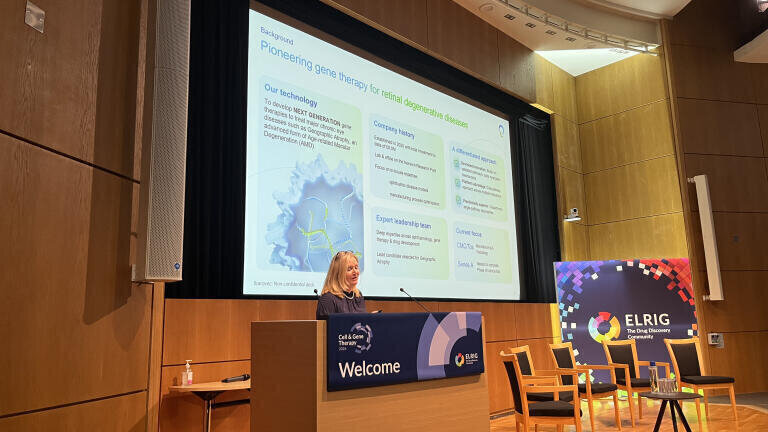
Dr Katie Binley, chief scientific officer at Ikarovec, outlined a dual-pathway gene therapy programme for geographic atrophy that aims to address one of the most persistent unmet needs in ophthalmology. In her presentation she set out the scientific case for IKAR-001, an ocular gene therapy designed to combine complement modulation with direct neuroprotection in just a single treatment, given at the ELRIG meeting in March 2026 at the Hinxton Hall Conference Centre on the Wellcome Genome Campus.
Her presentation focused on geographic atrophy as an advanced form of age-related macular degeneration that causes irreversible central vision loss and remains difficult to treat effectively. The disease affects around five million people worldwide and is characterised by progressive loss of retinal pigment epithelium cells and photoreceptors in the macula. As those cells die, patients lose the sharp central vision required to read, drive or recognise faces, with a consequent decline in independence and quality of life.
Current approved therapies for geographic atrophy have targeted the ‘complement cascade’ and have shown only modest efficacy. The complement cascade is part of the innate immune system that consists of a series of proteins which activate one another in sequence to defend the body against pathogens and damaged cells. These therapies can slow progression but they do not restore vision or produce meaningful improvement in visual function. They also require frequent intravitreal injections – typically monthly – which places a substantial burden on patients and clinics.
Binley characterised Ikarovec as a specialised company with expertise in ocular gene therapy and a deliberately hands-on scientific model. Much of its capability has been developed in house, including vector manufacture and optimisation, which has enabled control over early process development. Binley also highlighted the importance of Ikarovec being based on the Norwich Research Park, where access to shared support resources has made for an environment to aid development of a substantial proof-of-concept package.
Her presentation focussed on IKAR-001 which has been developed as a dual-pathway gene therapy. The construct has been designed to co-express two therapeutic agents from a single vector. The first is pigment epithelium-derived factor (PEDF) a neuroprotective protein with anti-inflammatory and anti-angiogenic properties. The second is soluble CD46 (sCD46) a complement modulator. Binley argued that this combination better reflects disease biology than a single-pathway approach.
Her reasoning was that geographic atrophy arises from multiple pathological processes. Complement dysregulation contributes to retinal damage but degeneration of retinal pigment epithelium cells and photoreceptors also plays a central role. A therapy that only suppresses complement activity may therefore slow part of the disease without adequately preserving neural tissue. By contrast, a combined approach could both limit damage and protect cells essential for visual function.
Binley outlined the rationale for PEDF as a neuroprotective factor with broader relevance in retinal disease. Its anti-inflammatory and anti-angiogenic properties may prove important, particularly given that some patients with age-related macular degeneration progress to neovascular disease. She noted that recombinant PEDF has a short half-life which limits its use in a conventional dosing sense. Gene therapy, however, offers a route to sustained intraocular expression after a single administration.
Effective therapeutic control requires intervention sufficiently upstream to prevent formation of the membrane attack complex which can damage cell membranes. CD46 emerged from Ikarovec’s internal screening as a strong candidate because of its potency, its activity at multiple points in the complement pathway and its suitability for retinal diffusion in soluble form. Complement inhibition is already a validated concept in geographic atrophy but Ikarovec here sought to incorporate this mechanism within its broader strategy.
Binley argued that the value of IKAR-001 lies not only in the presence of two payloads but in their complementary interaction. According to Ikarovec’s proof-of-concept models, IKAR-001 has combined protection of photoreceptors and retinal pigment epithelium cells with complement-modulating activity and has outperformed vectors that express only a single pathway component.
In complement assays, sCD46 reduced membrane attack complex deposition on retinal pigment epithelium cells. Comparative work has suggested that the construct performed strongly relative to other complement regulators. In angiogenesis assays, the PEDF component suppressed vascular network formation. These in vitro findings supported the rationale for co-expression within a single vector.
Binley also highlighted in vivo studies while acknowledging that no animal model can fully reproduce the geographic atrophy of the human eye. Even so, she argued that Ikarovec has assembled a package of coherent preclinical across relevant systems. In retinal damage models, IKAR-001 appeared to preserve retinal structure – including the outer nuclear layer – and it protects both photoreceptors and retinal pigment epithelium cells. Evidence also suggested preservation of retinal ganglion cells and maintenance of functional responses in electroretinography-type assessments. These findings indicate the potential to address multiple aspects of the disease’s biology.
The translational case was supported by safety data from non-human primate studies. Subretinal delivery of IKAR-001 showed a favourable safety profile alongside expression of both PEDF and sCD46 at functionally relevant levels. Ocular monitoring indicated good tolerability, preservation of retinal integrity and limited inflammation. Biodistribution studies detected transgene DNA and RNA in ocular tissues consistent with the intended pattern of retinal expression.
Considering broader applications Binley addressed the biological principles behind IKAR-001 to suggest it uses may extend beyond geographic atrophy to conditions such as retinitis pigmentosa and intermediate age-related macular degeneration. She also noted ongoing work on delivery technologies, including alternative capsids and routes of administration, with the aim to support earlier intervention or reduce reliance on subretinal surgery. Clinical development plans include strategies to enrich for faster-progressing patients and to use imaging biomarkers to detect treatment effects within feasible timelines.
In conclusion the message delivered was that Ikarovec has sought to reflect disease complexity in its therapeutic approach rather than reduce it to a single pathway. Complement inhibition has shown validity but does not fully address the underlying biology. IKAR-001 has been designed to combine complement modulation through sCD46 with neuroprotection through PEDF, with the aim to preserve retinal cells and function more effectively than current approaches yet it remains a preclinical proposition rather than a clinical outcome.
The programme has advanced sufficiently, however, to present a coherent translational case. Ikarovec has demonstrated mechanistic activity, tissue protection, appropriate ocular expression and a favourable non-human primate safety profile after subretinal delivery. In a field that still relies on frequent injections for modest benefit, that represents a credible and potentially more durable strategy.
ILM 51.6 Sept 2026



 Product directory
















.jpg)

.jpg)







.jpg)
