Laboratory events news
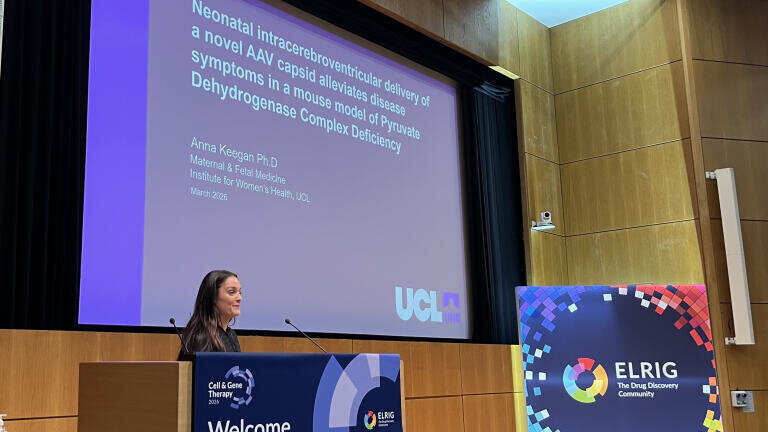
Research presented by Dr Anna Keegan of University College London at the ELRIG meeting in Hinxton described how improved adeno-associated viral vectors may strengthen brain-directed gene therapy for pyruvate dehydrogenase complex deficiency, a rare and devastating childhood mitochondrial disorder
Gene therapy approaches designed to improve delivery to the central nervous system (CNS) have shown encouraging preclinical results for pyruvate dehydrogenase complex deficiency – or PDHD – according to work presented by Dr Anna Keegan, a postdoctoral research fellow in the gene therapy team at University College London, at the ELRIG meeting in March 2026 at the Hinxton Hall Conference Centre on the Wellcome Genome Campus.
Keegan’s presentation set out a broader case for next-generation genetic medicines in rare disease, but the clearest disease-specific example concerned PDHD, a rare mitochondrial disorder of carbohydrate metabolism dysfunction that reduces the body’s capacity to produce energy. The condition arises because the enzyme complex pyruvate dehydrogenase fails to function properly. Under normal conditions, it converts pyruvate into acetyl-coenzyme A (acetyl-CoA) which then enters the Krebs cycle and supports adenosine triphosphate (ATP) production through oxidative phosphorylation. When that pathway breaks down, cells lose a crucial route to generate energy, and high metabolic demand tissues, such as the brain, can suffer profound damage.
Most patients with PDHD carry a mutation in the X-linked PDHA1 gene, which encodes the E1 alpha subunit of the pyruvate dehydrogenase complex. These mutations can lead to developmental delay, neurological abnormalities, lactic acidosis and early childhood death. Treatment options remain limited which has made the disorder an important unmet need and target for experimental gene therapy.
A central argument in Keegan’s talk was that rare diseases with a clear genetic basis are well suited to therapies that address the underlying molecular defect. She placed this within the wider rise of gene therapy as a platform technology with the potential to deliver long-lasting benefit after a single administration. However, she also made clear that such promise depends heavily on delivery. Even where a therapeutic gene is well chosen, success still rests on whether the vector can reach the right tissue, drive sufficient expression and avoid harmful off-target effects.
Keegan described adeno-associated virus (AAV) as a leading platform for gene transfer because of its relative safety and capacity to support durable transgene expression. Yet she also stressed that conventional AAV approaches still face important limits, particularly in diseases that require broad transduction across the brain. The challenge is not simply to enter the body, but to target the CNS efficiently while limit exposure in peripheral organs such as the liver, where off-target expression may raise safety concerns.
The PDHD study presents a proof-of-concept test of whether an engineered capsid could improve that balance. Using a brain-specific male knockout mouse model of Pdha1 deficiency that closely recapitulates human disease, the team compared a standard AAV9 vector with an engineered vector referred to as AAV-F. Newborn knockout mice received intracerebroventricular administration of titre-matched AAV9 or AAV-F gene therapy. Control animals received phosphate-buffered saline (PBS).
Over 100 days of development, 75 per cent of knockout mice treated with AAV-F survived, compared with 30 per cent of those given titre-matched AAV9. Over the same period not one PBS control knockout mouse survived. When AAV9 was administered at a dose one log higher, survival rose to 80 per cent. Taken together, these results suggested that the engineered AAV-F vector delivered a therapeutic effect in the CNS comparable with that of high-dose AAV9 but at a substantially lower dose.
This difference matters because vector dose can shape both efficacy and safety. In gene therapy, higher dose levels can help to overcome weak tissue targeting but they may also intensify the risk of toxicity and raise manufacturing burden. A vector that can produce a similar therapeutic benefit at a lower dose is therefore attractive not only from a biological standpoint but also from a regulatory perspective and translation into therapies that are deliverable to patients in the clinic.
Importantly, at postnatal day 18 and postnatal day 30, treated animals showed no significant difference from wild-type controls in conventional behavioural testing. However, artificial intelligence-based behavioural assessments at 100 days detected a significant reduction in locomotor function in surviving AAV-F-treated and AAV9-treated mice compared with wild-type animals. This indicated that treatment delivered substantial benefit without fully normalise long-term neurological function. Survival and early behavioural rescue improved markedly but residual deficits remained detectable when more sensitive methods were applied.
Biochemical and neuropathological findings supported the therapeutic effect. In the brain, both AAV-F and high-dose AAV9 restored pyruvate dehydrogenase complex enzyme activity and relative metabolite profiles to levels comparable with wild-type controls. Neuropathological analysis showed significant improvement in inflammation and neuronal loss throughout much of the brain in both treatment groups, although the cerebellum remained an exception. Cortical thinning, another marker of disease burden, was also significantly reduced after treatment with AAV-F and high-dose AAV9.
One of the most encouraging translational observations concerned off-target expression. AAV-F produced significantly lower liver transgene expression than high-dose AAV9. This result aligned closely with the wider message of Keegan’s talk which returned repeatedly to the need to improve biodistribution rather than chase expression alone. In CNS-directed gene therapy, strong activity in the target tissue is desirable but unnecessary expression in the liver can introduce and raise avoidable risks. A vector that de-targets the liver while preserving therapeutic activity in the brain may therefore offer a more clinically useful profile.
Although the work remains preclinical and caution remains, Keegan’s team’s findings presented at Hinxton suggested that PDHD may offer a compelling test case for more selective brain-directed gene therapy. Mouse models do not capture every feature of human disease and hence long-term safety, manufacturability and clinical dosing will all need careful evaluation before any therapy can move towards patients.
Nonetheless, for a disorder as severe as PDHC deficiency, where treatment options remain limited and prognosis is poor, the prospect carries real significance. Keegan’s data suggested that AAV engineering may do more than improve delivery metrics on paper. It may help to shift the therapeutic balance towards stronger efficacy in the brain, alongside lower off-target exposure and a more realistic path to clinical benefit.
ILM 51.6 Sept 2026



 Product directory
















.jpg)

.jpg)









.jpg)
