Laboratory events news
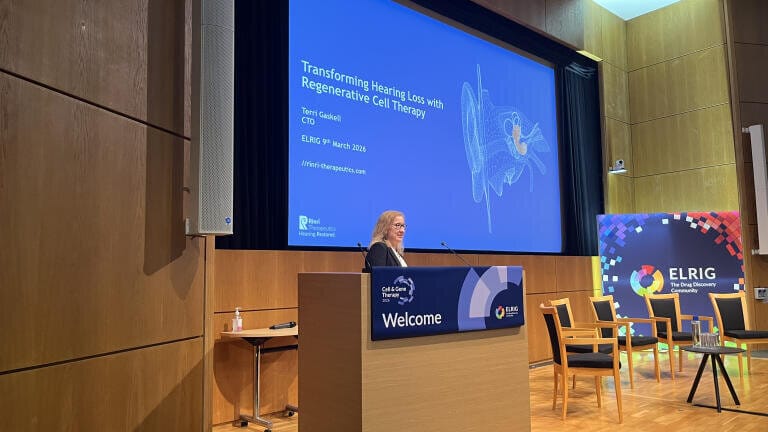
Dr Terri Gaskell told the ELRIG meeting that Rinri Therapeutics has built Rincell-1, an off-the-shelf regenerative cell therapy candidate for sensorineural hearing loss, through a development strategy that linked manufacturing, preclinical evidence, clinical design and future commercial scale-up from the outset
Hearing loss remains one of the most persistent challenges in regenerative medicine, and Dr Terri Gaskell argued at the ELRIG meeting that the field now requires restorative therapies rather than continued reliance on supportive devices. She described Rinri Therapeutics’ lead programme – Rincell-1 – as a stem-cell-derived therapy for sensorineural hearing loss that has progressed from academic origins to readiness for first-in-human clinical evaluation.
Hearing loss is the most common sensory disability worldwide and its incidence has increased as the average age of global populations increases. Around 90 per cent of cases arise from damage to, or loss of, cochlear sensory cells particularly hair cells and auditory neurons. This form – sensorineural hearing loss – has therefore become the primary target for regenerative strategies.
That rationale underpins Rinri’s decision to pursue a biological repair approach. Hearing aids and cochlear implants can provide benefit but they do not restore the underlying cellular architecture of the inner ear. Their effectiveness also depends on the integrity of neural pathways that transmit sound to the brain. Where auditory neurons are depleted, device performance may be limited. Gaskell’s argument was that a therapy which is able to replace or restore those neurons would address a major unmet need.
Rincell-1 has been developed with the aim to regenerate auditory neurons and restore signal transmission between the inner ear and central auditory pathways. Target populations include individuals with age-related neuronal decline and those with auditory neuropathy spectrum disorder, where sound enters the cochlea but neural signalling fails.
Gaskell emphasised that success in cell and gene therapy depends on alignment across the entire development pathway, including chemistry, manufacturing and controls, preclinical evidence, regulatory affairs planning, surgical delivery, clinical design, reimbursement and supply. She described these elements as interdependent rather than sequential and argued that early decisions strongly influence later feasibility, cost and risk. Developers should seek to define their endpoint from the outset rather than treat each stage in a silo.
Rinri was founded in 2019 as a spin-out from the University of Sheffield, and the company has built on two decades of sensory biology research to reach clinical readiness within around the next five to six years. Gaskell attributed that progress not only to scientific work but also to funding strategy, intellectual property protection and selective use of external partners. She noted that smaller companies in cell therapy cannot build all capabilities internally and must make disciplined choices about where to invest and with whom to collaborate.
Technically, Rincell-1 is an allogeneic therapy derived from pluripotent stem cells. Rinri has applied a developmentally-informed differentiation process to generate otic progenitors – precursor cells capable of forming specialised inner ear cell types. Following transplantation, these cells are expected to mature in vivo into auditory neurons. Differentiation takes place at around 12 days and is followed by a purification process. Cell expansion occurs later which supports scalability and may reduce manufacturing complexity. The expected required dose is relatively modest, at approximately 50,000 cells per cochlea.
Despite these advantages, Gaskell was clear about the challenges that remain. Transition from research-grade production to Good Manufacturing Practice-compliant manufacture is a slow and resource-intensive process. Technology transfer, raw material qualification, process verification and analytical development all require careful control. She warned that companies often underestimate this burden and so she urged developers to preserve samples, document process variables thoroughly and generate broad analytical datasets to support comparability, product characterisation and engagement in the necessary regulatory authorities.
Preclinical evidence for Rincell-1 has centred on a gerbil model of selective auditory neuron loss. Gerbils were chosen because aspects of their auditory system resemble those of humans. In this model, ouabain was used to ablate auditory neurons while preserving hair cells. Ouabain is a naturally occurring cardiac glycoside which acts by inhibiting the membrane enzyme Na⁺/K⁺-ATPase – the so-called ‘sodium–potassium pump’.
It maintains ionic gradients across the cell membrane which are essential for electrical activity and cellular homeostasis. Human-derived cells were delivered into the cochlea and Gaskell reported that transplanted cells survived, localised appropriately and expressed neuronal markers consistent with maturation. Functional benefit was also observed, with improvements in hearing thresholds that persisted over time.
Considering safety, Gaskell stated that extensive animal studies – including Good Laboratory Practice toxicology work – have shown no evidence of tumour formation or significant pathological effects linked to the therapy. She suggested that this dataset was sufficient to support a Clinical Trial Authorisation application.
Gaskell stressed that issues such as cochlear access, patient selection and endpoint definition are too important to defer. The first trial will enrol patients already scheduled for cochlear implant surgery which reduces additional procedural risk and allows direct access to the cochlea. The implant itself offers a means to monitor neural responsiveness longitudinally, providing an objective measure of biological activity.
This emphasis on quantifiable endpoints is central to the development plan. Gaskell described prior work in cochlear implant recipients in which neural responses were mapped across electrode arrays over time. High levels of patient participation enabled collection of detailed longitudinal datasets which have informed early efficacy measures. Such metrics are essential in first-in-human studies where evidence of biological effect must emerge within a practical timeframe.
Initial clinical cohorts reflect this strategy. One group will comprise older adults with age-related hearing loss, where neuronal degeneration contributes significantly to impairment. The second will include patients with auditory neuropathy spectrum disorder, whose pathology aligns closely with the therapeutic mechanism. In both cases, the aim is to target conditions in which neuronal dysfunction is central.
Gaskell also addressed the longer-term development pathway. Although current manufacturing can supply early clinical studies, later-stage development will require larger batch sizes, increased automation and reduced cost of goods. Rinri has explored scale-up strategies with the UK government’s ‘centre of excellence’ The Cell and Gene Therapy Catapult among other partners, including optimisation of adherent culture systems, development of scale-up bioreactor-compatible processes and improvements in analytical efficiency.
Future progress may also depend on advanced data tools with imaging, morphometric analysis and AI-based modelling helping to define predictive quality attributes for manufacturing control and product release. Single-cell analysis may further refine understanding of product identity, consistency and potency. Gaskell presented these capabilities as integral to development rather than a bolt-on at the end.
Taken together, the presentation outlined a programme designed not only tasked to be able to reach the patient in the clinic but also to progress towards commercial success. Gaskell’s argument that regenerative therapy for hearing loss will only be able to only if the scientific innovation in the laboratory is made to align with manufacturing, surgical practice, regulatory strategy and economic reality from the outset of the project.
Rinri Therapeutics has therefore positioned Rincell-1 as a potential shift in the treatment paradigm. Rather than compensate for lost function, the therapy aims to restore auditory neurons and re-establish neural signalling.
ILM 51.6 Sept 2026



 Product directory















.jpg)
.jpg)








.jpg)
