Laboratory events news
Dr Jeannine Hess examined how antimicrobial resistance already imposes a vast global death toll, why the antibiotic development pipeline has weakened and how her lab’s light-activated metal complexes might interfere with bacterial infections defences
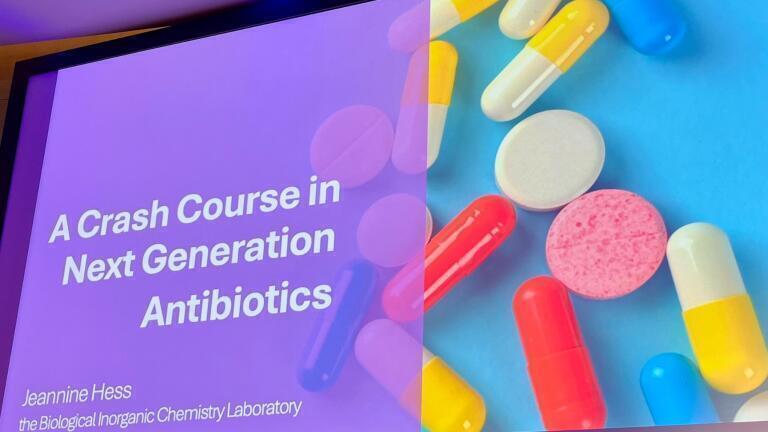
Opening her Francis Crick Institute Crash Course lecture, Dr Jeannine Hess, invited the assembled attendees to imagine the future, just a few years ahead.
“It is 2050 and you have been admitted to hospital for a routine hip replacement,” she said. The operation itself, Hess noted, is ‘standard and safe’, as it is today, but the ‘biggest risk’ in her 2050 scenario was not the surgery. No, it was the high chance that: “if you were to develop a [post-surgical] bacterial infection there might not be an effective antibiotic any longer”.
Dr Hess is the group leader of the Biological Inorganic Chemistry Laboratory at The Francis Crick Institute and a lecturer at King's College London. Her stark thought experiment was constructed to confront the audience with the near-term clinical threat that is posed by antimicrobial resistance (AMR). She underlined that it is no longer a distant policy concern.
Arguing that in the time that has passed since antibiotics were first discovered she asserted they have become so effective – and so embedded in everyday healthcare pathways – that modern medical systems have too long treated them as simply run-of-the-mill, rather than as a precious and finite resource.
Hess linked this point to mortality estimates that continue to shape international concern. Saying that bacterial infections now cause more than one million deaths (2021 data), she cited a long-range warning which estimates that annual mortality from resistance could exceed 10 million by 2050 and, in doing so, potentially overtake deaths from cancer (notwithstanding antibiotics’ critical role in oncology care pathways). AMR has already produced lethal outcomes at scale but could worsen without coordinated scientific and economic intervention.
Turning to her lab’s work in the field, Hess said her programme at The Crick is aiming to use inorganic chemistry to produce novel therapeutic strategies that could extend the effectiveness of the pool of antibiotics currently in use but which are failing in efficacy against bacteria that have developed resistance.
Before she moved on to describe her specialist chemistry, she paused to reiterate the basics. Bacteria, she said, exist in the human body and across environmental systems, many species of which support vital biological functioning. A person’s skin, mouth and gut host vast microbial populations, most of which do not cause disease. Antibiotics are tasked therefore to operate in a narrow technical and ethical space. They must target harmful bacteria while preserving patient safety and limiting collateral biological damage.
Hess defined an antibiotic in straightforward terms as an agent that kills bacteria or stops bacterial growth. She tied that definition to the wider architecture of modern medicine. Intensive care, chemotherapy, transplantation, obstetric surgery and orthopaedic procedures all rely on – in truth, lean very heavily on – infection control that includes dependable antibacterial therapy. Lose that reliability, she implied, and clinical risk rises across the system, not only in cases of disease infection.
The design problem for novel drugs, she said, has remained unusually hard. Antibiotics must strike bacterial targets while sparing human eukaryotic cells. She used a domestic analogy to illustrate this selectivity whereby the right key should open your front door, not the front door of every house on your street.
At a cellular level, bacteria differ from human cells but Hess cautioned that those differences do not provide limitless drug targeting options. Bacteria lack both a membrane-bound nuclei and many of the compartmental structures that define eukaryotic organisation. Yet this relative simplicity can leave fewer selective weak points for drug developers to exploit.
She grouped major antibiotic mechanisms into a small number of familiar classes:
Underlining target scarcity, she returned repeatedly to a practical principle that medicinal chemists know well which is to identify a target first before solving the delivery problem. A compound must enter the bacterial cell, persist at an effective concentration and reach its molecular objective. Failure at any step along the way prevents success.
Describing several bacterial countermeasures that undermine each stage, Hess spoke about cell envelopes which can block entry, especially in Gram-negative species that carry additional permeability barriers. Additionally, bacteria can alter envelope composition under drug pressure with efflux pumps that eject antibiotic compounds that do break through and enter its cells.
When an enzyme attempts to degrade an antibiotic directly the microbe can deploy a defence of target-site mutations which can reduce binding and preserve its viability. Resistance, she said, is not an exceptional event but a predictable outcome of competitive selection. Exposure kills susceptible cells; survivors expand and desirable traits are inherited and protective DNA sequences can even be passed between different types of bacteria.
From there Hess gave a historical perspective to underscore how today’s bottlenecks have emerged. She argued that AMR did not arrive suddenly and that historical context matters for future policy and pipeline design.
She referred to early use of natural anti-infective remedies and cited a seventeenth-century book Theatrum Botanicum (1640) by John Parkinson (1567 – 1650) who was royal apothecary to King James I and later to King Charles I. In it he recorded that the application of mouldy bread to infected wounds stemmed infection. Hess then traced the conceptual bridge to modern medicine through Paul Ehrlich (1854 – 1915), a German physician-scientist who helped to found modern immunology and targeted drug design. Ehrlich’s foundational insight, Hess said, was that compounds can show selective biological interaction rather than indiscriminate toxicity. This discovery led to the development of arsphenamine – also known as Salvarsan – which was an antimicrobial drug introduced in 1909 to treat syphilis and was arsenic-based.
Hess’ historical narrative then reached Sir Alexander Fleming’s penicillin observation at St Mary’s hospital which serves the area of Paddington, London. Contamination and inhibition on a culture plate revealed potent antibacterial activity from mould-derived compounds.
Hess noted Fleming’s well-known words:
“When I woke up just after dawn on September 28, 1928, I certainly didn’t plan to revolutionise all medicine by discovering the world’s first antibiotic, or bacteria killer. But I suppose that was exactly what I did. I did not invent penicillin. Nature did that. I only discovered it by accident.”
This underlines a defining twentieth-century strategy of scientists mining microbial competition to identify antibacterial molecules. Fleming’s work kicked off the ‘golden age’ of antibacterial discovery in which multiple antibiotic classes entered clinical use from the 1940s to the 1960s.
But in Hess’s analysis, this early optimism has eventually proved to be costly. Confidence that bacterial infection had been broadly solved reduced the urgency to spur further discovery just as resistance selection continued unnoticed. Indeed, Fleming noted in his 1945 Nobel acceptance speech: “…that if penicillin is used at too low a dose, microbes can be exposed without being eliminated, which can select resistant strains…”
Easy discoveries, as Hess put it, have become harder to find. And emphasising an immutable fact that still shapes the field: the moment an antibiotic enters widespread use the evolutionary pressure it exerts on bacteria begins to erode its efficacy and durability. New discovery is not therefore a one-off triumph. We have been shooting at a moving target all along, even if we didn’t know it.
Turning to the central case study from her laboratory, Hess spoke to how her group has sought to expand medicinal chemistry beyond familiar organic frameworks by incorporating transition metals into designed complexes. She described this as an effort to broaden available molecular shape space. Organic compounds often occupy linear or planar geometries, like as Hess put it, “pencils or sheets of paper”.
Metal complexes can, however, access three-dimensional architectures that are harder to achieve with standard carbon-centred molecules. These novel architectures can alter their potential for effective biological interactions.
She stressed that metal-based therapeutics already sit within mainstream medicine, citing platinum agents used in oncology, gold compounds in rheumatology and silver in infection control for severe burns asserting that while not every metal complex will succeed, this modality is clinically legitimate and chemically underused in antibacterial research.
The research detailed in Hess’ talk relied on certain metal complexes absorbing light and so entering an excited state to transfer energy to oxygen, which generates highly reactive oxygen species that can damage specific targets. This has practical attractions in both spatial and temporal controls. Researchers can activate toxicity where and when illumination occurs rather than deploy a system-wide active cytotoxin.
Hess considers selectivity to be the decisive test. Her team are designing a targeted construct in which a metal complex is linked to a binding motif that she likened to a molecular ‘GPS tracker’ for a resistance-associated bacterial protein.
In her example, the target was a metallo-beta-lactamase in Escherichia coli (E. coli), called NDM-1. When the resistant E. coli bacteria express this enzyme it can hydrolyse beta-lactam antibiotics and inactivate them. The strategy therefore aims not to replace beta-lactams directly but to disable the resistance mechanism of the bacteria that goes on to neutralise them.
Hess said her group identified a targeting motif which was attached to a photoreactive metal core and tested alongside a non-targeted comparator for controls. They could therefore verify that the complexes retained light-responsive behaviour and could produce reactive oxygen species. In enzyme assays, the targeted construct showed measurable inhibition in the dark and substantially stronger inhibition under illumination. The experimental data determined an approximately 25-fold performance gain against the non-targeted control in relevant conditions, which suggested that target-directed proximity contributed strongly to effect.
Hess also described selectivity work in mixed-protein systems where without a light source, proteins would remain largely intact. Under light, the targeted construct preferentially damaged the intended resistance enzyme while sparing any non-target proteins, supporting the claim that localisation can constrain collateral damage even with reactive species chemistry.
Cellular access is then the next barrier to overcome. Hess reiterated that target quality alone cannot deliver efficacy if compounds fail to reach intracellular sites. She used an advantage of certain metal complexes – intrinsic luminescence under light – to record uptake in bacterial cells by microscopy and complementary laboratory methods.
With entry established, the team tested enzyme inhibition in bacteria that expressed the resistance determinant. She said the targeted complex retained activity in the dark and improved by around 30-fold with light exposure, while the non-targeted analogue showed little effect in that cellular context.
The clinically relevant question was whether this approach could restore antibiotic activity. To test this, Hess compared both susceptible and resistant strains of E. coli. She found that the complexes themselves had high minimum inhibitory concentrations and did not function as stand-alone antibiotics.
However, when researchers combined the targeted complex with a beta-lactam and applied light, the drug recommenced its antibiotic activity – a response consistent with resistance-enzyme disruption that permitted partner antibiotics to be able to work effectively again.
Hess closed by shifting from bench science to market design. She said antibiotic economics remain misaligned with the growing philosophy among healthcare professionals for antibiotic and, more broadly, antimicrobial stewardship. Health systems must preserve the more potent agents and restrict the use of even first-line medicines. This suppresses (potential) sales volume even when novel products are medically important.
She used the analogy of a fire extinguisher to capture this paradox. You might want to keep a fire extinguisher to hand but it would be undesirable to have to routinely use it. Development costs and failure risk are similarly high compared to other therapeutic drug research areas, but expected returns are lower. The economics – rather than the unmet medical need – has discouraged sustained private-sector investment in novel antibiotic science.
She said that there is a nascent policy response that combines push incentives for early-stage research with pull incentives that reward successful delivery of clinically valuable antibiotics even when use stays limited. One such approach is a subscription model and Hess noted that the UK’s National Health Service has begun to implement this approach with two companies and two new types of antibiotic, an attempt to decouple developer revenue from high-volume prescribing.
In discussion, Hess placed AMR within the World Health Organization’s One Health framework that links human medicine, agriculture and environmental reservoirs. She urged prudent use, where antibiotics are prescribed only for confirmed bacterial infection. She acknowledged the growing interest in phage therapy while noting that her own group does not focus on that modality. She said metal choice in her platform depends on required properties, including photo-reactivity and safety profile, and she indicated a preference to prioritise biologically familiar – and safe – metals where it was feasible.
The lecture’s final message was unsentimental. The evolution of antimicrobial resistance has not paused and will not pause because the current pipeline looks weak. Hess argued that progress now requires two parallel moves: broader chemical imagination at the laboratory bench and durable economic reform at system level. Without both, routine procedures could once again face risks that twentieth-century medicine believed had pushed to the margins.
ILM 51.6 Sept 2026




 Product directory
















.jpg)

.jpg)