Laboratory products
Published over 15 years ago. See the latest and most current information on Laboratory products.
Dr Patricia Barral and her colleagues study the cellular and molecular mechanisms controlling lymphocyte activation and eventual fate. Knowledge of these processes is invaluable not only in increasing our understanding of the causes of cancer but also in the treatment and prevention of infectious and autoimmune diseases. The Lymphocyte Interaction Laboratory was the first team to establish a role for a group of macrophages in acquiring antigen and presenting intact antigen to follicular B cells in lymph nodes in vivo. Now, they have identified a novel role for CD169+ macrophages in activating Invariant Natural Killer T (iNKT) cells.
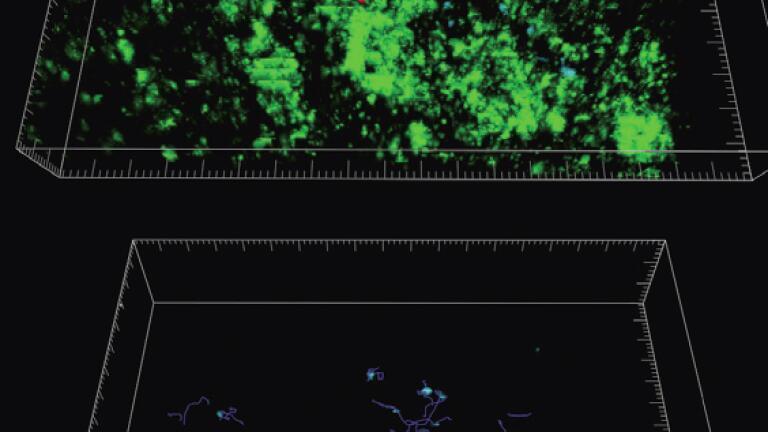
Using Bitplane Imaris, the world’s leading 3D/4D image visualisation and analysis software, Barral and her co-workers transformed image stacks acquired from multi-photon examination of the lymph nodes into volume-rendered 4-D movies for analysis. Cell movement was automatically tracked and the Imaris software also calculated average and instantaneous cell speeds together with displacement and the confinement index. Imaris was also able to demonstrate the confinement of the iNKT cells in the vicinity of the CD169+ macrophages following administration of particulate lipid antigen by reconstructing the lymph nodes in three dimensions.
In these studies, the research team successfully used Imaris to visualize the long-standing interactions between CD169+ macrophages and iNKT cells and found very fast iNKT activation and cytokine secretion. These processes are probably very important factors during the early stages of immune responses and host defence.
“Imaris offers life scientists a uniquely powerful and versatile solution for the visualisation, analysis and interpretation of 3-D and 4-D images,” said Marcin Barszczewski at Bitplane. “Fast, precise and easy-to-use, Imaris accepts images from almost all wide field and confocal microscopes and combines with a range of seven specialist modules for additional flexibility, such as MeasurementPro, Track, Coloc and FilamentTracer.”
ILM 51.6 Sept 2026




 Product directory






















.jpg)