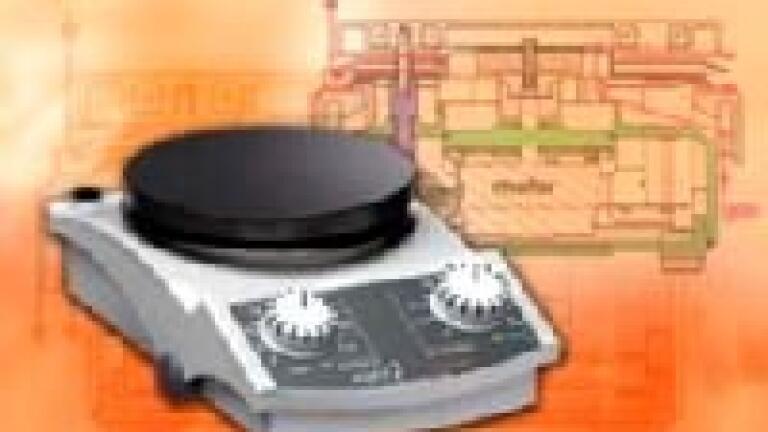
The hotplate is one of the most frequently used laboratory tools. Asynt have applied their expertise in chemical synthesis to the design of a new hotplate system that eliminates most of the problems and nuisances experienced with traditional hotplates.
For example, a common problem, particularly with viscous materials, is that magnetic stirrers will decouple from the drive during start up and may never recover. This new design maintains efficient magnetic coupling by "ramping" the stirrer speed, ensuring continuous and effective stirring even with up to 20 litres of liquid.
800 watts of heating power combined with the possibility of using an external Asynt immersion sensor gives fast heating over a 20-300°C temperature range with the assurance that the solution is actually at the desired temperature.
The hotplate itself is made of silumin, an aluminium/silicon alloy with excellent corrosion and scratch resistance that is further enhanced with a ceramic coating. For extra safety, the external housing is hermetically sealed so that if spillages or leaks do occur, liquid and gases cannot reach the drive or electronics.
When more control accuracy is required, the unit can be used with an Asynt Electronic Temperature Controller, giving ±0.5°C temperature control and the added convenience of direct digital temperature readout.




 Product directory